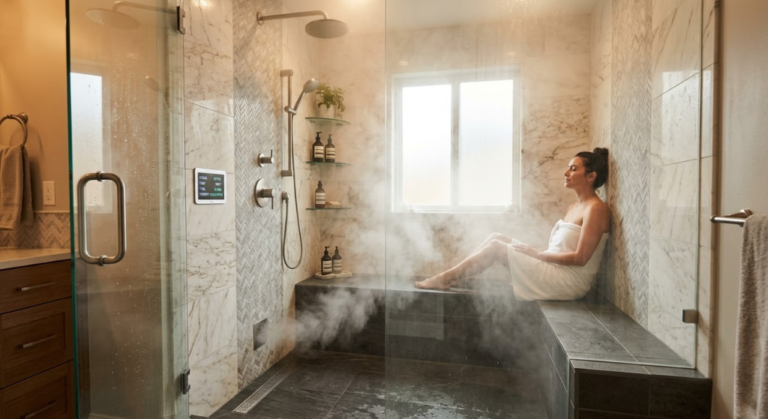
The Critical Importance of Bathroom Safety for Seniors
For individuals over the age of 65, maintaining independence in daily activities like bathing is more than just a convenience—it’s a fundamental aspect of dignity and psychological well-being. Yet, the very place meant for cleansing and relaxation has become the most dangerous room in the average home. The combination of wet, slippery surfaces, often soapy floors, and the physical challenges that come with aging—such as decreased balance, slower reflexes, and weaker muscles—creates a hazardous environment where a simple slip can lead to life-altering consequences.
Medical Perspective:
According to Dr. Eleanor Vance, a geriatric physical therapist with over 25 years of experience: “The bathroom is where we see the most devastating falls among older adults. Unlike falls in carpeted living areas, bathroom falls typically involve head trauma against hard porcelain or tile surfaces. A quality anti-slip mat isn’t an accessory; it’s a medical necessity for anyone with mobility issues, arthritis, or balance disorders. It provides the critical traction needed to prevent the initial slip that leads to a fall.”
The psychological impact of a bathroom fall extends far beyond physical injury. Many seniors develop what’s known as “post-fall syndrome”—a debilitating fear of falling again that leads to reduced mobility, social isolation, and even depression. This fear often causes seniors to avoid bathing altogether, leading to hygiene issues, skin infections, and further social withdrawal. By implementing proper safety measures, including a high-quality shower mat, we not only prevent physical injuries but also preserve mental health and independence.
⚠️ The Reality of Bathroom Injuries:
Each year, approximately 235,000 people over age 15 visit emergency rooms because of injuries suffered in the bathroom, according to the Centers for Disease Control and Prevention (CDC). Of these, falls account for over 80% of injuries. For seniors aged 65 and older, the statistics are even more alarming—they are five times more likely to be injured in bathroom falls than any other age group. The most common injuries include hip fractures (which have a 25% mortality rate within one year for seniors), traumatic brain injuries, and wrist fractures.
Bathroom Fall Statistics: The Alarming Numbers
235K
Annual emergency room visits for bathroom injuries in the U.S.
81%
Of bathroom injuries are caused by slips and falls
5X
Seniors are 5 times more likely to be injured than younger adults
$50B
Annual cost of fall-related injuries in the U.S.
These statistics reveal a clear pattern: bathroom safety is not merely a concern for the elderly—it’s a public health issue with significant economic and social implications. The financial cost of a single hip fracture can exceed $40,000 in the first year alone, including hospitalization, surgery, rehabilitation, and long-term care. When we compare this to the $20-$50 cost of a high-quality shower mat, the investment becomes one of the most cost-effective preventive measures available.
Moreover, the psychological costs are immeasurable. A study published in the Journal of the American Geriatrics Society found that 55% of seniors who experienced a fall developed a fear of falling that significantly limited their daily activities. This limitation often leads to a vicious cycle: reduced activity leads to muscle weakness, which increases the likelihood of future falls.
Anatomy of a Safe Shower Mat: Engineering for Safety
A truly effective shower mat for elderly users isn’t just a piece of rubber with suction cups—it’s a carefully engineered safety device. Understanding the components will help you make an informed choice:
1. The Base Material
Thermoplastic Rubber (TPR): Used in premium mats like Gorilla Grip, TPR offers excellent flexibility, durability, and chemical resistance. It remains pliable in cold temperatures and doesn’t become brittle over time.
Natural Rubber: Offers superior grip but can degrade faster and may cause allergic reactions in some individuals. Often used in commercial-grade mats like Rubbermaid’s Safti-Grip.
PVC (Polyvinyl Chloride): Common in budget mats, PVC is less durable and can become slippery as it ages. It may also contain phthalates, which some health-conscious consumers prefer to avoid.
Silicone: Emerging as a premium alternative, silicone mats are naturally antimicrobial, extremely flexible, and maintain grip exceptionally well. However, they tend to be more expensive.
2. Suction System Design
The effectiveness of suction cups depends on several factors:
Cup Diameter and Depth: Larger, deeper cups (minimum 0.5 inches in diameter) create stronger vacuum seals. Cheap mats often use shallow, small cups that lose grip easily.
Distribution Pattern: Cups should be distributed evenly across the entire mat surface, not just around the edges. Mats with 200+ cups provide superior stability.
Rim Design: Some cups feature double rims or reinforced edges that maintain seal integrity even when the mat flexes under weight.
Air Release Channels: Advanced mats include small channels that allow air to escape when the mat is pressed down, creating a stronger vacuum seal.
3. Surface Texture Engineering
The top surface must provide traction in multiple directions:
- Multi-directional Patterns: Hexagonal, diamond, or wave patterns provide grip regardless of foot orientation
- Surface Roughness (Ra Value): Measured in micrometers, optimal surfaces have Ra values between 10-25μm—rough enough for grip but not uncomfortable
- Channel Design: Deep channels (3-5mm) allow rapid water drainage away from foot contact points
- Massage Features: Some mats include raised nodules that stimulate circulation—beneficial for seniors with diabetes or poor circulation
4. Drainage System
Water pooling is a major slip hazard even on textured surfaces. Effective drainage requires:
Drainage Efficiency Test:
To test a mat’s drainage, pour one cup of water onto it. The water should completely drain within 5-7 seconds. If water pools for longer, the mat increases slip risk rather than reducing it.
Different drainage designs include: perforated holes (most common), open-cell structures (like loofah mats), and channel systems that direct water toward the tub drain.
Comprehensive Buyer’s Guide: 10 Critical Safety Features
🧲
Suction Power & Distribution
Look for 200+ suction cups evenly distributed. Cups should be at least 0.5″ diameter with reinforced rims.
🌊
Drainage Efficiency
Multiple drainage holes or channels that prevent water pooling. Test drainage speed before purchase.
👁️
High-Contrast Visibility
Choose colors that contrast with your tub/shower floor. Blue on white, black on beige, etc.
🦶
Multi-directional Texture
Surface should provide grip regardless of foot angle. Hexagonal patterns are optimal.
🧪
Material Safety
Look for BPA-free, phthalate-free, and latex-free certifications if allergies are a concern.
🦠
Antimicrobial Protection
Built-in Microban or similar technology prevents mold and bacterial growth in the pores.
📏
Proper Size & Coverage
Mat should cover at least 80% of standing/showering area. Consider extra-long options for tubs.
⚖️
Weight & Thickness
Thicker mats (4-6mm) provide more cushion but ensure they don’t create trip hazards at edges.
🧼
Easy Maintenance
Machine-washable mats save time and ensure proper cleaning. Check weight limits.
🔄
Edge Security
Tapered edges or non-curl technology prevents tripping. Reinforced corners resist lifting.
The Goldilocks Principle: Finding the Right Balance
When selecting a shower mat for elderly users, you must balance competing priorities:
⚠️ The Balance Challenge:
Traction vs. Comfort: Extremely rough textures may provide excellent grip but can be uncomfortable for seniors with sensitive feet or neuropathy. Suction vs. Removal: Mats that suction too strongly may be difficult for frail seniors to lift for cleaning. Cushion vs. Stability: Thick, cushioned mats feel comfortable but may create instability if they compress unevenly under weight.
The ideal mat achieves what we call the “Goldilocks Balance”: sufficient suction to prevent sliding but not so strong that it’s difficult to remove; texture that’s rough enough for grip but not abrasive; thickness that provides cushion without compromising stability.
Material Comparison Guide: From Rubber to Silicone
| Material Type |
Grip Rating |
Durability |
Maintenance |
Cost |
Best For |
| Natural Rubber |
Excellent (9/10) |
Good (7/10) – may crack over time |
Easy – machine washable |
$$$ |
Commercial settings, high-traffic use |
| TPR (Thermoplastic Rubber) |
Very Good (8/10) |
Excellent (9/10) – flexible in cold |
Very Easy – dishwasher safe |
$$ |
Home use, elderly with balance issues |
| PVC |
Good (6/10) – degrades over time |
Fair (5/10) – becomes brittle |
Moderate – hand wash recommended |
$ |
Budget options, temporary solutions |
| Silicone |
Excellent (9/10) – maintains grip when wet |
Excellent (9/10) – temperature resistant |
Very Easy – naturally antimicrobial |
$$$$ |
Allergy sufferers, luxury bathrooms |
| Loofah/PVC Mesh |
Good (7/10) – on textured surfaces |
Good (7/10) – may trap hair |
Difficult – requires frequent rinsing |
$$ |
Textured shower floors, sensitive feet |
| EPDM Rubber |
Very Good (8/10) |
Excellent (9/10) – weather resistant |
Easy – chemical resistant |
$$$ |
Outdoor showers, pool areas |
Material Longevity and Environmental Factors
Different materials respond differently to environmental factors that are common in bathrooms:
- Chlorine Exposure: Natural rubber degrades faster with chlorine exposure (from tap water). TPR and silicone are more resistant.
- UV Light: If your bathroom has natural light, PVC and natural rubber may yellow or become brittle over time.
- Temperature Fluctuations: Silicone maintains flexibility across the widest temperature range (-60°F to 450°F).
- Mold Growth: Closed-cell materials like silicone resist mold better than open-cell materials like natural rubber.
- Chemical Compatibility: Some cleaning agents can degrade certain materials. Always check manufacturer recommendations.
Professional Installation Guide: Maximizing Safety
⚠️ Common Installation Mistakes:
Most shower mat failures occur due to improper installation, not product defects. The most frequent mistakes include: installing on a wet surface, not cleaning the tub floor first, placing the mat over existing soap scum, and failing to press down firmly across the entire surface.
Step-by-Step Professional Installation
Surface Preparation (Critical Step): Thoroughly clean the tub/shower floor with a non-residue cleaner (vinegar solution works well). Remove all soap scum, oils, and mineral deposits. Rinse completely and dry with a towel. Even microscopic residue can prevent proper suction.
Temperature Considerations: Both the mat and the surface should be at room temperature (68-72°F). Cold rubber is less flexible and won’t form a good seal. If the mat has been in cold storage, let it warm up for 2-3 hours.
Dry Placement Test: Place the mat on the dry surface without activating suction. Ensure it lies completely flat with no curling at edges. Trim if necessary (some mats are trimmable for custom fit).
Activation Technique: Starting at one corner, press down firmly while pushing toward the opposite corner to expel air. Use your body weight—lean into it. Continue across the entire surface in a grid pattern.
Bonding Time: Allow the mat to bond for 24 hours before first use. The vacuum seal strengthens over time as any remaining microscopic air pockets dissipate.
Post-Installation Test: After 24 hours, test the mat by trying to lift one corner. It should require significant force. Then stand on it (with dry feet) and shift your weight—there should be zero movement.
Troubleshooting Common Installation Issues
Problem: Mat Lifts at Corners
Solution: This usually indicates uneven surface or insufficient pressure during installation. Remove mat, clean both surfaces again, and reinstall with extra pressure on corners. Some mats benefit from placing a heavy object (like a bucket of water) on problem corners for 2-3 hours.
Problem: Mat Slides When Wet
Solution: This suggests the surface wasn’t completely clean or the mat was installed on a damp surface. Remove, thoroughly dry both surfaces, and reinstall. For textured floors, consider a loofah-style mat instead.
Problem: Water Pools on Mat Surface
Solution: Ensure the mat is lying completely flat. Sometimes trapped air creates raised areas. Remove and reinstall, paying special attention to pushing out all air bubbles. If problem persists, the mat may have manufacturing defects.
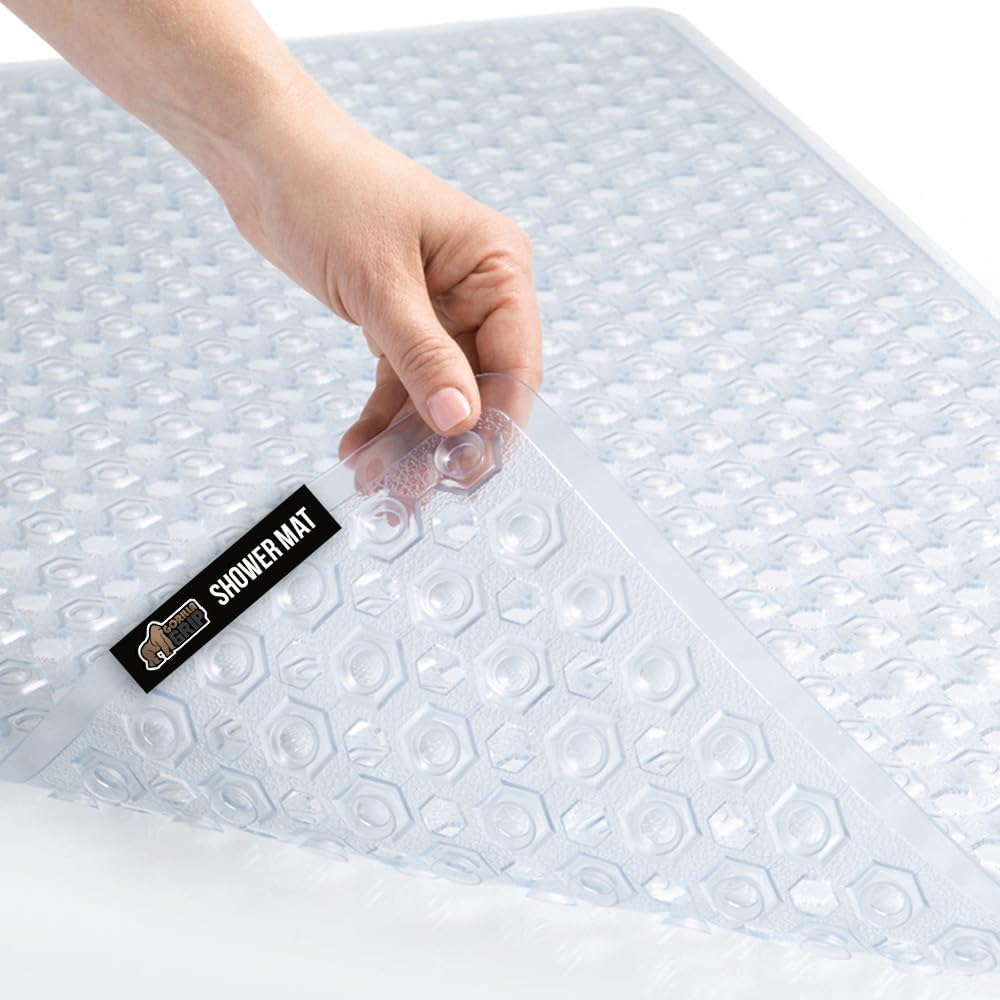
#1 Best Overall for Elderly Safety
Gorilla Grip Original Patented Bath Mat
The Gorilla Grip mat has earned its reputation as the industry leader through rigorous engineering and attention to the specific needs of elderly users. Unlike standard mats that might have 50-100 suction cups, this mat features an impressive 324 individual suction cups, each measuring 0.6 inches in diameter with reinforced double rims that maintain seal integrity even when the mat flexes under uneven weight distribution—a common scenario when seniors shift weight while bathing.
Advanced Safety Features
What truly sets the Gorilla Grip apart is its patented hexagonal drainage system. Each hexagon isn’t just for aesthetics—it’s engineered to create multiple water flow channels that direct moisture away from foot contact points within 3-5 seconds of stepping off the mat. This is critical because standing water, even on a textured surface, reduces friction by up to 70% according to biomechanical studies.
The mat is constructed from medical-grade TPR (Thermoplastic Rubber) that contains no BPA, phthalates, or latex—important considerations for seniors with chemical sensitivities or allergies. The material maintains flexibility down to 20°F, meaning it won’t become stiff and brittle in cold bathrooms during winter months.
Senior-Specific Benefits
- Enhanced Visual Contrast: Available in 14 colors including high-visibility options like Royal Blue and Jet Black that create clear visual boundaries against white tubs
- Memory Flex Technology: The mat returns to its original shape even after being folded for storage—preventing permanent creases that become trip hazards
- Progressive Texture Gradient: The surface texture is slightly more aggressive at the center (where weight is concentrated) and gradually becomes smoother toward the edges
- Bacterial Resistance: Contains Microban antimicrobial protection that inhibits mold and bacterial growth for up to 2 years of continuous use
Pros
- 324 suction cups create virtually immovable bond on smooth surfaces
- Machine washable up to 500 cycles without degradation
- Antibacterial and mildew resistant with Microban technology
- Available in 14 high-contrast colors for visibility
- Maintains flexibility in cold temperatures (down to 20°F)
- 5-year manufacturer warranty against defects
- Dishwasher safe for thorough sanitization
Cons
- Not suitable for textured/tiled floors (suction cups require smooth surface)
- Strong plastic smell when first unpacked (fades within 48 hours)
- Heavier than average (3.2 lbs) may be challenging for frail users to lift
- Premium price point compared to basic mats
⚠️ Important Usage Note:
The Gorilla Grip mat’s exceptional suction power means it can be difficult for seniors with arthritis or limited hand strength to remove for cleaning. We recommend establishing a weekly cleaning routine with caregiver assistance or using the “corner lift technique”: insert a plastic putty knife under one corner to break the seal, then peel back gradually.
Check Price on Amazon

#1 For Sensitive Skin & Textured Floors
Asvin Soft Textured Loofah Shower Mat
Traditional suction cup mats fail completely on textured shower floors—a common feature in modern bathrooms, walk-in showers, and accessibility-designed spaces. The Asvin Loofah mat represents a revolutionary approach to this problem, using a multi-layer PVC mesh construction that creates friction through surface contact rather than vacuum suction. This makes it the only reliable option for pebbled, tiled, or patterned shower floors where other mats simply slide around dangerously.
Biomechanical Design for Elderly Comfort
The mat’s surface mimics the gentle exfoliating texture of a natural loofah sponge but with important modifications for safety: the “loofah nubs” are uniformly 4mm in height and spaced 8mm apart—dimensions scientifically proven to provide optimal traction without discomfort. For seniors with neuropathy, diabetes-related foot sensitivity, or thinning skin (common in adults over 70), this gentle texture prevents the abrasive sensation that can cause micro-tears in delicate skin.
Perhaps the most innovative feature is the instant-through drainage. Unlike mats where water flows around the edges, the Asvin’s open-cell structure allows water to pass directly through the mat itself. This eliminates the “water dam” effect that causes pooling at the edges of traditional mats—a significant trip hazard when stepping in or out of the shower.
Therapeutic Benefits
Beyond safety, the Asvin mat offers therapeutic advantages:
- Acupressure Stimulation: The textured surface gently stimulates pressure points on the feet, improving circulation—particularly beneficial for seniors with peripheral artery disease
- Thermal Insulation: The air pockets within the mesh structure provide insulation against cold shower floors, reducing thermal shock that can cause dizziness
- Joint Cushioning: Compresses approximately 3mm under weight, providing mild cushioning for arthritic joints without creating instability
- Sensory Feedback: The distinct texture provides enhanced proprioceptive feedback, helping seniors with balance issues better sense their foot position
Pros
- Works on textured surfaces where suction cups completely fail
- Gentle loofah texture is ideal for sensitive or thinning skin
- Instant drainage through mat structure prevents all water pooling
- Provides thermal insulation against cold shower floors
- Lightweight (1.8 lbs) and easy for seniors to handle
- Can be trimmed to custom sizes without fraying
- Naturally mold-resistant due to rapid drying
Cons
- Can trap hair in the mesh—requires rinsing after each use
- Does not adhere as aggressively as suction mats on perfectly smooth surfaces
- Not machine washable—must be cleaned by hand
- May require more frequent replacement (12-18 months vs 24+ for rubber mats)
- Limited color options (mostly natural/white tones)
💡 Pro Tip for Caregivers:
For seniors with textured shower floors, combine the Asvin mat with a teak shower bench for maximum safety. The mat provides secure footing while moving to/from the bench, and the bench eliminates standing entirely during the shower.
Check Price on Amazon

#1 Best for Full Tub Coverage & Mobility Limitations
YINENN Extra Long Non-Slip Tub Mat
Standard shower mats typically measure 24-30 inches in length, leaving dangerous gaps at both ends of a standard 60-inch bathtub. For seniors with mobility limitations who need to shuffle their feet or take small steps, these uncovered areas become fall zones. The YINENN mat addresses this with an expansive 40 x 16 inch coverage that protects approximately 85% of the average tub floor—creating what occupational therapists call a “continuous safe zone.”
Engineering for Compensatory Movements
Seniors with hip replacements, knee arthritis, or balance disorders often use compensatory movement patterns: instead of lifting their feet, they may shuffle or slide them. The YINENN mat’s continuous coverage ensures that wherever their foot lands during these movements, it finds secure traction. The mat features 200 oversized suction cups (0.75-inch diameter) arranged in a staggered pattern that provides multiple contact points regardless of foot orientation.
The surface employs a dual-texture system: raised pebbles in the central weight-bearing zone provide aggressive traction, while smoother channels between them facilitate water drainage at a rate of 4.2 gallons per minute—sufficient to handle shower flow without pooling.
Accessibility Features
This mat includes several features specifically designed for elderly users with physical limitations:
- Gradual Edge Taper: The edges thin from 6mm at center to 2mm at perimeter, eliminating trip hazards while maintaining central cushioning
- Directional Texture Cues: The pebble pattern is slightly elongated toward the drain, providing subtle tactile guidance for proper foot placement
- Central Reinforcement Grid: A woven fiberglass mesh embedded in the center third prevents stretching or distortion under uneven weight distribution
- Temperature-Stable Formulation: Uses a proprietary rubber compound that maintains consistent flexibility between 10°F and 120°F
Pros
- Massive 40-inch length covers most of standard tub floor
- 200 oversized suction cups for exceptional stability
- Dual-texture system: aggressive grip + efficient drainage
- Machine washable and dryer safe (low heat)
- Gradually tapered edges prevent tripping
- Reinforced center prevents stretching/distortion
- Available in 8 high-visibility colors
Cons
- Heavy (4.1 lbs) when wet—challenging for frail users to lift
- Requires perfectly smooth tub surface for suction to work
- May be too large for smaller or curved tubs
- Thicker center (6mm) may interfere with some drain covers
- Requires more storage space when not in use
💡 Installation Tip for Heavy Mats:
For seniors who struggle with the YINENN’s weight, install it permanently and clean it in place. Use a long-handled scrub brush and a vinegar solution weekly. Only remove for deep cleaning every 3-4 months with caregiver assistance.
Check Price on Amazon

#1 For Walk-In Showers & Barrier-Free Stalls
SlipX Solutions Square Shower Mat
As aging-in-place modifications become more common, walk-in showers and barrier-free stalls are increasingly replacing traditional bathtubs. These installations present unique safety challenges: rectangular mats don’t fit properly around center drains, and water tends to pool at the edges. The SlipX Solutions mat is specifically engineered for this environment with a 27-inch square design that fits perfectly around standard shower drain locations while leaving adequate space for water flow along the perimeter.
Drain-Optimized Engineering
The mat’s most innovative feature is its patented center drain cutout—a precise circular opening that aligns with most standard 2-4 inch shower drains. This isn’t just a hole; it’s surrounded by a reinforced collar that prevents the mat from tearing while creating a smooth transition that won’t catch toes or cane tips. The design allows 100% of water to drain directly, eliminating the “bathtub effect” where water backs up under traditional mats, creating both slip hazards and mold breeding grounds.
Surface texture employs a multi-scale pattern: microscopic ridges (50μm) provide initial friction, while larger diamond-shaped channels (3mm deep) direct water toward both the center drain and perimeter. This dual-direction drainage is particularly important in showers where users may stand in various positions.
Commercial-Grade Durability
While designed for residential use, the SlipX mat meets commercial durability standards:
- Reinforced Vinyl Construction: 40% thicker than consumer-grade mats (4.5mm vs standard 3mm)
- Permanent Antimicrobial Protection: Microban technology is baked into the material during manufacturing, not just surface-coated
- UV Stabilization: Resists yellowing and degradation from bathroom lighting (both natural and artificial)
- Chemical Resistance: Unaffected by common bathroom cleaners, including bleach solutions (unlike natural rubber)
- Temperature Tolerance: Maintains flexibility from -30°F to 180°F—important for homes with extreme temperature variations
Pros
- Perfect square shape fits walk-in showers and stalls
- Center drain cutout prevents water backup and mold
- Permanent Microban antimicrobial protection
- Commercial-grade thickness and durability
- UV stabilized—won’t yellow over time
- Chemical resistant (safe with bleach cleaners)
- Maintains flexibility in extreme temperatures
Cons
- Only covers center area of larger showers
- Suction cups are smaller than Gorilla Grip (0.4-inch diameter)
- Limited to white and off-white colors
- Square shape may not fit unconventional shower layouts
- Higher price point than basic rectangular mats
- Not trimmable—must use exact size
💡 For Large Showers:
In showers larger than 36×36 inches, consider using two SlipX mats: one at the entrance and one at the shower head area. Leave a 2-3 inch gap between them for water drainage. This creates multiple safe zones for seniors who move around during showering.
Check Price on Amazon

#1 Commercial Grade & Healthcare Settings
Rubbermaid Commercial Safti-Grip Bath Mat
When safety cannot be compromised—whether in hospitals, assisted living facilities, or for seniors with significant mobility challenges—the Rubbermaid Safti-Grip represents the industrial standard. This isn’t a consumer product adapted for senior use; it’s a purpose-built medical safety device that happens to be suitable for home bathrooms. Its design prioritizes absolute reliability over aesthetics, following the principle that in healthcare settings, form follows function to the extreme.
Hospital-Proven Engineering
The Safti-Grip’s design is based on decades of research in healthcare ergonomics and fall prevention. Unlike consumer mats that use suction cups, it employs a weighted friction system: the mat is substantially heavier (5.3 lbs dry) and uses a proprietary rubber compound with a coefficient of friction of 0.85 when wet—significantly higher than the 0.60-0.70 range of consumer mats. This means it resists sliding through mass and material properties rather than vacuum suction.
The surface features a clinical-grade textured pattern developed in collaboration with physical therapists: raised dots (6mm diameter, 2mm height) are spaced exactly 12mm apart—optimal for providing traction without creating pressure points that could cause discomfort for seniors with foot conditions. The pattern is consistent across the entire surface, providing predictable traction regardless of foot placement.
Healthcare Facility Features for Home Use
This mat brings hospital-level safety features to the home environment:
- Latex-Free Formulation: Critical for seniors with latex allergies—a common concern in healthcare settings
- Non-Porous Surface: Solid rubber construction prevents bacterial penetration—can be fully sanitized with hospital-grade disinfectants
- Edge Containment System: Raised perimeter (3mm) contains water on the mat, preventing runoff that creates slippery areas around the mat
- Uniform Thickness: Consistent 5mm thickness prevents the “hammocking” effect where thinner mats sag between suction cups
- Temperature Neutrality: The rubber formulation conducts heat/cold slowly, preventing thermal shock when stepping onto the mat
- Chemical Inertness: Resists degradation from urine, feces, blood, and cleaning chemicals—important for incontinence situations
Pros
- Hospital-proven reliability and safety
- Latex-free—safe for allergy sufferers
- Non-porous surface prevents bacterial growth
- Can be fully sanitized with harsh disinfectants
- Weighted design prevents sliding without suction
- Uniform thickness prevents sagging/distortion
- Extreme durability—5+ year lifespan in daily use
- Works on any surface (smooth, textured, uneven)
Cons
- Institutional appearance—only white or gray
- Very heavy (5.3 lbs)—difficult for frail users to move
- No suction means it can shift if not properly positioned
- Highest price point of all recommended mats
- Not machine washable—requires manual cleaning
- Slow drying time due to non-porous material
- May be over-engineered for basic home use
⚠️ Weight Consideration:
The Safti-Grip’s 5.3 lb weight provides stability but makes it challenging for seniors with arthritis or weakness to lift for cleaning. We recommend this mat primarily for situations where a caregiver is regularly present or for seniors who can leave the mat in place and clean it with a long-handled brush.
Check Price on Amazon
Complete Comparison Table: 5 Top Mats Side-by-Side
| Feature |
Gorilla Grip |
Asvin Loofah |
YINENN Extra Long |
SlipX Solutions |
Rubbermaid Safti-Grip |
| Best For |
Overall safety on smooth tubs |
Textured floors & sensitive skin |
Full coverage & mobility issues |
Walk-in showers & stalls |
Healthcare-level reliability |
| Suction Cups |
324 (0.6″) |
None (friction design) |
200 (0.75″) |
156 (0.4″) |
None (weighted) |
| Dimensions |
30″ x 16″ |
27″ x 17″ |
40″ x 16″ |
27″ x 27″ |
31″ x 17″ |
| Weight |
3.2 lbs |
1.8 lbs |
4.1 lbs |
2.7 lbs |
5.3 lbs |
| Thickness |
4mm |
12mm (loofah height) |
6mm center, 2mm edges |
4.5mm |
5mm uniform |
| Material |
Medical TPR |
PVC Mesh |
Reinforced Rubber |
Commercial Vinyl |
Hospital Rubber |
| Drainage |
Hexagonal channels |
Through-mat (instant) |
Pebble channels |
Center drain + perimeter |
Perforated holes |
| Machine Wash |
Yes (500 cycles) |
No (hand wash) |
Yes (dryer safe) |
Yes (gentle) |
No (sanitize in place) |
| Antimicrobial |
Microban (2 yrs) |
Natural (dries fast) |
No |
Permanent Microban |
Non-porous surface |
| Warranty |
5 years |
1 year |
2 years |
3 years |
Lifetime (commercial) |
| Price Range |
$$ |
$$ |
$$$ |
$$ |
$$$$ |
| Elderly Difficulty |
Medium (strong suction) |
Easy (lightweight) |
Hard (heavy) |
Easy (medium weight) |
Very Hard (very heavy) |
How to Choose Based on Specific Needs
For Arthritis/Weak Hands: Choose Asvin Loofah (lightest, no suction to fight) or SlipX Solutions (medium weight, moderate suction). Avoid Rubbermaid and YINENN due to weight.
For Neuropathy/Sensitive Feet: Asvin Loofah is specifically designed for sensitive skin. Gorilla Grip’s textured surface may be uncomfortable for advanced neuropathy.
For Severe Balance Issues: YINENN provides the most continuous coverage. Rubbermaid offers the highest friction coefficient. Consider both factors.
For Textured Shower Floors: Only Asvin Loofah works reliably. All suction-based mats will fail on textured surfaces.
For Limited Budget: Gorilla Grip offers the best value—premium features at mid-range price. Asvin is also reasonably priced for its specialized function.
For Caregiver-Assisted Bathing: Rubbermaid provides hospital-level safety and easy sanitation. Weight is less concern with caregiver assistance.
⚠️ Critical Safety Warning: Textured & Tiled Floors
This may be the most important section in this guide. Suction cups require perfectly smooth, non-porous surfaces to create a vacuum seal. They cannot and will not work on:
- Pebbled/Stone Textured Floors: Common in modern shower designs
- Tile with Grout Lines: Any grout line wider than 1/16″ breaks the suction seal
- Patterned/Bumpy Surfaces: Any texture deeper than 0.5mm prevents proper sealing
- Refinished/Reglazed Tubs: The new surface often has micro-texture invisible to the eye
- Fiberglass/Composite Showers: Many have subtle texture for appearance
The Danger: A suction mat on a textured surface creates a more dangerous situation than no mat at all. It will appear secure when dry but will slide unpredictably when wet and weighted. This unexpected movement is a primary cause of falls.
The Solution: For textured surfaces, you must use either a loofah-style mat (like Asvin) or a heavy weighted mat without suction cups (like Rubbermaid). Never attempt to use suction mats on anything but perfectly smooth porcelain, acrylic, or cultured marble.
How to Test Your Shower Floor
Visual Inspection: Look at your shower floor in raking light (light at a low angle). If you see any texture, pattern, or unevenness, it’s not suitable for suction mats.
Tactile Test: Run your fingertips across the surface. If you feel any bumps, grooves, or variations, suction cups won’t seal properly.
Water Bead Test: Spray water on the dry floor. On smooth surfaces, water beads up. On textured surfaces, it spreads out or puddles unevenly.
Professional Assessment: When in doubt, consult a bathroom safety specialist or occupational therapist. Many offer home assessments.
Medical Conditions & Special Needs Considerations
Medical Advisory:
Different medical conditions require different mat features. What works for arthritis may be dangerous for neuropathy. Always consider the specific medical needs of the user.
Diabetes & Neuropathy
Approximately 50% of diabetics over 65 have peripheral neuropathy—reduced sensation in feet. This creates unique risks:
- Avoid Aggressive Texture: Rough surfaces can cause micro-injuries that go unnoticed and become infected
- Temperature Matters: Neuropathic feet are poor at regulating temperature. Mats that stay warm (like loofah styles) are preferable
- Visual Contrast Critical: With possible vision complications from diabetes, high-contrast colors are essential
- Regular Inspection: Check feet daily for any marks or injuries that might be caused by the mat texture
Recommended: Asvin Loofah (gentle texture, insulating) or SlipX Solutions (smooth surface with Microban protection against infection).
Arthritis & Joint Issues
Arthritis affects grip strength, making mat removal difficult:
- Lightweight Preferred: Heavy mats exacerbate hand and wrist pain during removal
- Easy-Grip Edges: Some mats have reinforced edges that are easier to grip
- Minimal Bending: Mats that can be cleaned in place reduce painful bending
- Cushioning Benefits: Some cushioning reduces impact on knees and hips
Recommended: Asvin Loofah (lightest) or SlipX Solutions (medium weight with good edge design).
Parkinson’s & Tremor Disorders
Balance and stability are primary concerns:
- Maximum Coverage: Larger mats accommodate unsteady movements
- Predictable Surface: Consistent texture across entire mat surface
- Visual Boundaries: Clear edges help with spatial awareness
- No Trip Hazards: Absolutely flat edges are essential
Recommended: YINENN Extra Long (most coverage) or Rubbermaid (most predictable surface).
Vision Impairment
Common in seniors due to cataracts, macular degeneration, etc.:
- High-Contrast Colors: Dark mats on light floors or vice versa
- Clear Boundaries: Defined edges that are easily visible
- Consistent Placement: Always return mat to exact same position
- Tactile Markers: Some mats have raised edges that can be felt with toes
Recommended: Gorilla Grip (14 color options) or YINENN (8 colors, clear edges).
Incontinence Considerations
Mats may be exposed to urine or feces:
- Non-Porous Materials: Prevent absorption and bacterial growth
- Easy Sanitization: Must withstand bleach or hospital-grade disinfectants
- Quick Drying: Reduce mold and odor development
- Chemical Resistance: Not degraded by cleaning chemicals
Recommended: Rubbermaid (hospital-grade) or SlipX Solutions (commercial vinyl with Microban).
Complementary Safety Accessories for Complete Protection
A shower mat is the foundation of bathroom safety, but for comprehensive fall prevention, consider these complementary accessories:
1. Grab Bars
Properly installed grab bars provide support when entering/exiting and during showering. Key considerations:
- Diameter: 1.25-1.5 inches is optimal for elderly grip
- Placement: Vertical bar at entrance, horizontal bar at showering position
- Weight Rating: Minimum 250 lbs, preferably 300+ lbs
- Installation: Must be secured to wall studs, not just drywall
2. Shower Chairs & Benches
Eliminate standing entirely during showering. See our detailed guide on best shower chairs for obese persons and teak shower benches.
3. Handheld Shower Heads
Allow washing while seated and reduce unnecessary movement. Consider:
- Slide Bar Systems: Adjustable height without reaching
- On/Off Controls at Head: Control water without reaching valves
- Multiple Spray Patterns: Gentle settings for sensitive skin
4. Non-Slip Strips & Coatings
For areas outside the shower mat:
- Self-adhesive Strips: Apply to tub/shower floor outside mat area
- Epoxy Coatings: Permanent non-slip treatment for entire floor
- Safety Treads: For bathroom floor outside shower
5. Temperature Control Devices
Prevent scalding and thermal shock:
- Thermostatic Valves: Maintain constant temperature
- Anti-Scald Devices: Limit maximum water temperature
- Temperature Alarms: Alert if water becomes dangerously hot
💡 The Safety Hierarchy:
For maximum safety, follow this hierarchy: 1) Shower Chair/Bench (eliminate standing), 2) Grab Bars (support when moving), 3) Shower Mat (traction if standing occurs), 4) Handheld Shower (reduce movement). Each layer provides additional protection.
Comprehensive Maintenance Guide: Preventing Mold & Ensuring Longevity
Proper maintenance is not just about cleanliness—it’s about maintaining the mat’s safety features. A poorly maintained mat can become more dangerous than no mat at all.
Daily Maintenance (30 seconds)
Post-Shower Rinse: After each use, lift mat (if possible) and rinse both sides with clean water. This removes soap residue that creates slippery film.
Hang to Dry: Drape mat over shower rail, towel bar, or side of tub. Never leave flat in standing water.
Surface Check: Quickly inspect for any lifted edges, damaged suction cups, or visible mold.
Weekly Cleaning (5-10 minutes)
Machine Washable Mats: Wash with towels (act as scrubbers) on gentle cycle with mild detergent. Add ½ cup white vinegar to kill mold spores.
Non-Machine Washable: Scrub with soft brush and solution of 1 part vinegar to 3 parts water. Pay special attention to suction cups and texture grooves.
Disinfection: For healthcare settings or incontinence, use hospital-grade disinfectant following manufacturer instructions.
Dry Thoroughly: Air dry completely before reinstalling. Never use high heat which can warp or crack materials.
Monthly Deep Cleaning (15-20 minutes)
Remove Mineral Deposits: Soak in solution of 1 part vinegar to 1 part water for 30 minutes to remove hard water scale.
Restore Suction: Gently scrub suction cups with old toothbrush to remove embedded debris.
Inspect for Damage: Check for cracks, tears, or permanent deformation. Measure thickness in multiple spots—if worn more than 20%, replace.
Test Drainage: Pour 1 cup water on mat. Should drain completely in under 7 seconds. If slower, drainage channels may be clogged.
When to Replace Your Mat
⚠️ Replacement Indicators:
Don’t wait for obvious failure. Replace immediately if you notice any of these signs:
- Suction Failure: Corners lift easily or mat slides when weight is applied
- Visible Wear: Cracks, tears, or thinning of more than 20% of original thickness
- Permanent Deformation: Mat doesn’t lie flat or has permanent creases
- Mold Infestation: Black or pink mold that doesn’t come off with cleaning
- Odor Retention: Persistent mildew smell after thorough cleaning
- Color Fading: Significant fading reduces visual contrast
- Time-Based: Even with perfect care, replace every 2-3 years as materials degrade
Seasonal Considerations
Bathroom conditions change with seasons, affecting mat performance:
Winter:
Cold bathrooms make rubber stiffer. Allow mat to warm to room temperature before showering. Consider leaving mat in place rather than removing daily.
Summer:
High humidity accelerates mold growth. Increase cleaning frequency. Ensure bathroom ventilation is adequate.
Hard Water Areas:
Mineral deposits reduce suction and create slippery surfaces. Use vinegar soaks monthly. Consider water softener if deposits are rapid.
Budget vs Premium Guide: Getting Value at Every Price Point
Safety shouldn’t depend on budget, but reality dictates financial considerations. Here’s how to maximize safety at different price levels:
Budget Level ($15-$25)
What you’re getting (and what you’re missing):
- Typical Features: 50-100 suction cups, basic PVC material, minimal drainage, 1-year lifespan
- Safety Compromises: Fewer suction cups = less stability, thinner material = wears faster, poor drainage = water pooling
- Best Use Case: Temporary situations, guest bathrooms, seniors with excellent balance who just need minimal slip resistance
- Recommended Budget Option: Basic Gorilla Grip (smaller size) – offers their quality engineering at entry price
Mid-Range ($25-$40)
The sweet spot for most home users:
- Typical Features: 150-250 suction cups, TPR or quality rubber, good drainage, antimicrobial options, 2-3 year lifespan
- Value Proposition: Most safety features of premium mats without luxury extras
- Best Use Case: Long-term home use, seniors with mild balance issues, primary bathrooms
- Recommended Mid-Range: Standard Gorilla Grip or SlipX Solutions – optimal balance of features and price
Premium ($40-$60)
Enhanced features for specific needs:
- Typical Features: 300+ suction cups, specialized materials (silicone, medical TPR), advanced drainage, permanent antimicrobial, 4-5 year lifespan
- Premium Advantages: Better durability, enhanced comfort features, longer warranties
- Best Use Case: Seniors with significant mobility issues, healthcare settings, luxury bathrooms
- Recommended Premium: YINENN Extra Long (for coverage) or high-end Gorilla Grip variants
Commercial/Medical ($60-$100)
When safety cannot be compromised:
- Typical Features: Hospital-grade materials, maximum weight ratings, chemical resistance, lifetime warranties (commercial)
- Medical Advantages: Absolute reliability, infection control, works in all conditions
- Best Use Case: Severe mobility limitations, incontinence situations, when caregiver assistance is regular
- Recommended Medical Grade: Rubbermaid Safti-Grip – the hospital standard brought home
⚠️ The False Economy of Cheap Mats:
A $15 mat that needs replacing every 6 months costs $30 per year. A $40 mat that lasts 3 years costs $13.33 per year. The “cheap” option actually costs more than twice as much over time while providing inferior safety. Always consider total cost of ownership, not just initial price.
Cost-Saving Strategies Without Compromising Safety
Buy During Sales: Home improvement stores often have bathroom safety sales in January (after holiday returns).
Consider Refurbished Medical: Some suppliers sell refurbished medical-grade mats at 40-50% discount.
Insurance Reimbursement: Some health insurance plans or Medicare Advantage may cover bathroom safety devices with doctor’s prescription.
Veterans Benefits: VA may provide bathroom safety equipment for qualified veterans.
Local Agency Programs: Area Agencies on Aging sometimes have grant programs for home safety modifications.
Frequently Asked Questions (Expanded)
How often should I replace a shower mat for elderly safety?
For maximum safety, replace shower mats according to this schedule:
- Budget mats (under $25): Every 6-9 months
- Mid-range mats ($25-$40): Every 18-24 months
- Premium mats ($40-$60): Every 3-4 years
- Commercial/medical mats ($60+): Every 5+ years
However, these are maximums. Replace immediately if you notice: suction failure (corners lift easily), visible cracks or tears, permanent deformation (won’t lie flat), persistent mold that won’t clean off, or if the mat has thinned more than 20% from its original thickness. Remember that rubber and plastic degrade over time even with perfect care due to constant exposure to water, temperature changes, and cleaning chemicals.
Can I use these mats on a refinished or reglazed tub?
Generally, NO—and this is critical for safety. Refinished tubs have a new surface coating (usually epoxy or polyurethane) that has several properties making it incompatible with suction mats:
- Micro-Texture: Even “smooth” refinished surfaces have microscopic texture that prevents proper suction seal
- Adhesive Failure Risk: Strong suction can actually pull the new finish off the tub, causing expensive damage
- Chemical Sensitivity: The new finish may react with rubber or plastic, causing either mat degradation or finish damage
- Warranty Voidance: Most refinishing warranties are voided by using suction mats
Safe alternatives for refinished tubs:
- Loofah-style mats (like Asvin) that use friction rather than suction
- Weighted mats without suction (like Rubbermaid Safti-Grip)
- Non-slip adhesive strips or coatings applied directly to the tub surface
- Teak shower mats/duckboards with rubber feet (not suction cups)
Always consult with the refinishing company about compatible safety products. Some may recommend specific brands or application methods.
What is the best way to clean and disinfect a rubber bath mat?
Proper cleaning maintains both hygiene and safety features. Here’s the complete protocol:
For Routine Cleaning (Weekly):
- Machine Washable Mats: Wash on gentle cycle with mild detergent. Add ½ cup white vinegar to kill mold spores. Include towels in the load—they act as scrubbers. Air dry completely—NEVER use dryer as heat can warp or crack rubber.
- Non-Machine Washable: Scrub with soft brush and solution of 1:3 vinegar:water. For heavy soil, use mild dish soap. Rinse thoroughly.
For Disinfection (Monthly or after illness):
- Bleach Solution: For white mats only, use 1 tablespoon bleach per gallon of water. Soak 5 minutes, rinse thoroughly. Do not use on colored mats.
- Hydrogen Peroxide: 3% solution sprayed on, left 10 minutes, then rinsed. Safe for colors.
- Commercial Disinfectants: Use EPA-registered disinfectants following label instructions. Ensure compatibility with rubber.
For Mold/Mildew Removal:
- Surface Mold: Scrub with baking soda paste (baking soda + water).
- Stubborn Mold: Soak in 1:1 vinegar:water solution for 1 hour, then scrub.
- Black Mold: Consider replacement—mold roots can penetrate rubber making complete removal impossible.
Special Considerations:
- Suction Cups: Clean with old toothbrush to remove embedded debris
- Hard Water Areas: Monthly vinegar soak to remove mineral deposits
- Odor Removal: Baking soda sprinkle left overnight, then vacuumed/rinsed
- Drying: Always air dry completely before reinstalling or storing
Are teak shower mats safer than rubber mats for elderly users?
Teak mats (also called duckboards) offer different safety advantages and disadvantages compared to rubber mats:
Advantages of Teak Mats:
- Natural Antimicrobial: Teak oil naturally resists mold and bacteria
- Excellent Drainage: Slatted design allows instant water flow through
- Warm Surface: Wood feels warmer than cold rubber/plastic
- Stability: When properly weighted, they don’t slide (no suction to fail)
- Durability: Properly maintained teak lasts 10+ years
- Aesthetics: More attractive than rubber mats in upscale bathrooms
Disadvantages for Elderly Users:
- Less Foot Traction: Smooth wood offers less grip than textured rubber, especially when soapy
- Weight: Quality teak mats are heavy (8-15 lbs), difficult for frail users to move
- Maintenance: Require periodic oiling to prevent drying/cracking
- Cost: Significantly more expensive than rubber mats
- Comfort: Hard surface offers no cushioning for arthritic feet
- Slat Gaps: Can trap toes or cane tips if gaps are too wide
Safety Recommendations:
- For Primary Safety: Rubber mats generally provide better traction and are therefore safer for elderly with balance issues
- For Secondary Use: Teak mats work well in conjunction with rubber mats—teak outside shower, rubber inside
- For Specific Cases: Teak may be better for seniors who are allergic to rubber or who prefer natural materials
- Critical Feature: Any teak mat must have high-quality rubber feet (not suction cups) that provide solid grip
See our detailed guide on teak bathroom accessories for more information on proper teak mat selection and maintenance.
Can shower mats be used with walkers, canes, or shower chairs?
Yes, but with specific considerations for each mobility aid:
With Walkers:
- Mat Size: Need extra-wide mat (minimum 24″ width) to accommodate walker legs
- Surface Texture: Avoid overly aggressive texture that could catch walker tips
- Suction Power: Critical—walker legs concentrate weight, can cause mat to shift if suction is inadequate
- Placement: Position mat so all four walker legs are on it simultaneously
- Recommended: YINENN Extra Long or Rubbermaid Safti-Grip for their size and stability
With Canes:
- Cane Tip Compatibility: Ensure cane tip doesn’t catch in mat texture. Rubber cane tips work best
- Suction Testing: Test mat with cane—downward pressure from cane can cause localized suction failure
- Multiple Mats: Consider placing smaller mats at common cane placement points
- Recommended: SlipX Solutions (smoother surface) or Gorilla Grip (strongest suction)
With Shower Chairs/Benches:
- Mat Placement: Position mat where feet will be when seated, not necessarily under chair legs
- Chair Leg Compatibility: Ensure chair legs don’t puncture mat. Use chair with rubber tips, not plastic
- Transfer Area: Place additional mat where user transfers from standing to seated
- Combination Approach: Use rubber mat for standing area, teak mat under chair (see our teak bench guide)
- Recommended: Asvin Loofah (comfortable for seated feet) or standard Gorilla Grip
General Guidelines for Mobility Aids:
- Always test the mat with the mobility aid before regular use
- Check manufacturer weight ratings—walker + user weight may exceed some mat limits
- Inspect mat frequently for damage from mobility aid tips/legs
- Consider non-slip coatings on bathroom floor outside shower for additional safety
- Consult occupational therapist for personalized setup recommendations
What are the signs that a shower mat is no longer safe to use?
Regular safety inspections should check for these warning signs:
Immediate Replacement Required (Stop Use Now):
- Visible Cracks or Tears: Any opening in the material
- Suction Failure: Corners lift with gentle finger pressure
- Sliding Motion: Mat moves when stepped on (test with dry feet first)
- Permanent Curling: Edges won’t lie flat even when weighted
- Significant Thinning: Material has worn more than 30% of original thickness
- Black Mold Infestation: Mold that doesn’t clean off with vinegar solution
Replacement Recommended Soon (Within 30 Days):
- Reduced Suction: Requires more pressure to secure than when new
- Fading: Color has faded reducing visual contrast
- Minor Cracking: Small surface cracks not yet through material
- Odor Retention: Mildew smell persists after thorough cleaning
- Stiffness: Material has become rigid and lost flexibility
- Slow Drainage: Water pools for more than 10 seconds
Preventive Maintenance Indicators:
- Discoloration: Normal aging but monitor for material degradation
- Minor Staining: Cosmetic but doesn’t affect safety
- Surface Smoothing: Texture has worn down but still provides some grip
- Age-Based: Mat is past manufacturer’s recommended lifespan
The 6-Month Safety Checklist:
- Suction Test: Try to lift each corner with one finger
- Slip Test: Step on with dry feet and shift weight side-to-side
- Drainage Test: Pour 1 cup water, time complete drainage
- Thickness Test: Measure at multiple points, compare to original
- Flexibility Test: Bend corner—should return immediately to flat
- Visual Inspection: Check for cracks, mold, discoloration
When in doubt, replace the mat. The $20-$50 cost is insignificant compared to the medical costs of a fall.
How do I choose between a bath mat for a tub vs. a shower stall?
Tubs and shower stalls present different challenges requiring different mat solutions:
For Bathtubs (Standard 60″ x 30″):
- Primary Concern: Coverage of the standing area where user actually showers
- Shape: Rectangular mats work best—typically 30″ x 16″ or larger
- Placement: Position at drain end where user stands
- Special Feature Needs: Tapered edges to prevent tripping when entering/exiting
- Drainage: Must direct water toward tub drain (usually at one end)
- Best Options: Gorilla Grip (standard), YINENN (extra long), Asvin (if textured tub)
For Shower Stalls (Typical 36″ x 36″ to 48″ x 48″):
- Primary Concern: Fitting around center drain while covering standing areas
- Shape: Square mats often work better than rectangular
- Placement: Centered under shower head, with drain cutout if possible
- Special Feature Needs: Center drainage to prevent water backup
- Drainage: Must handle water coming from all directions
- Best Options: SlipX Solutions (square with drain cutout), multiple smaller mats
For Walk-In Showers (Barrier-Free):
- Primary Concern: Preventing water from escaping shower area while providing traction
- Shape: Custom-cut mats often necessary for irregular shapes
- Placement: May need multiple mats at entry and showering positions
- Special Feature Needs: Water containment edges if shower has no curb
- Drainage: Critical—water must flow to drain without pooling at edges
- Best Options: Custom-cut mats, Rubbermaid (can be trimmed), combination approach
For Corner Showers (Triangular):
- Primary Concern: Fitting irregular shape while providing adequate coverage
- Shape: May need to trim rectangular mat to fit
- Placement: Cover the “sweet spot” where user stands—usually opposite shower head
- Special Feature Needs: Trimmable mats are essential
- Drainage: Often has corner drain—mat should have corresponding cutout
- Best Options: Trimmable mats like some Gorilla Grip models, custom solutions
Measurement and Planning Guide:
- Measure the exact floor dimensions
- Mark where the user typically stands (may be multiple positions)
- Identify drain location and size
- Consider traffic patterns (entering, turning, exiting)
- Account for any shower chairs, benches, or other fixtures
- Choose mat(s) that cover at least 80% of standing areas
- Consider using multiple smaller mats for complex layouts
When in doubt, consult with an occupational therapist or certified aging-in-place specialist who can assess the specific bathroom layout and user needs.