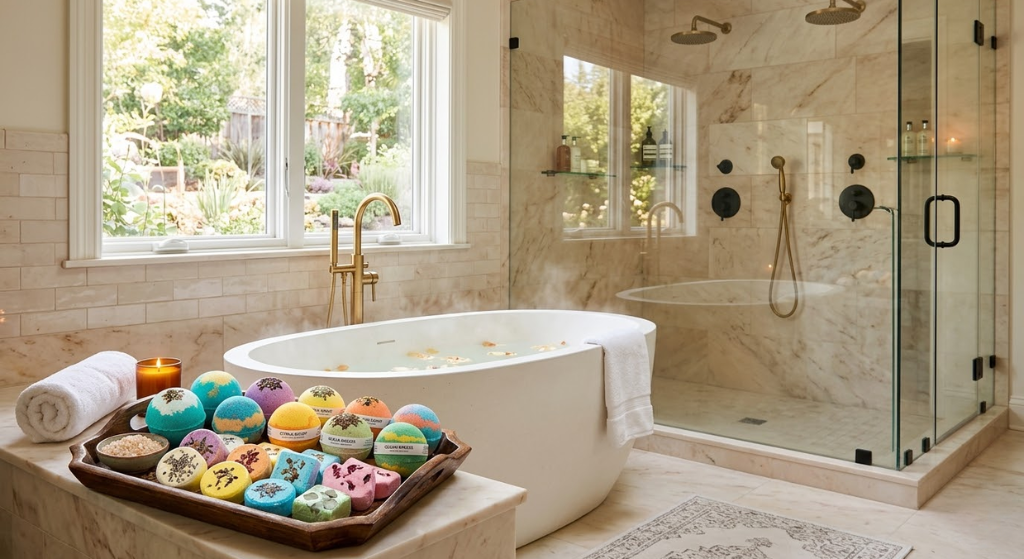
Bath bombs, shower steamers, bath salts, body oil, quartz — the bathroom wellness world has exploded with products and materials, and the line between “shower product” and “bath product” has never been more blurred. People want to use what they have, in the space they have, and end up with questions that sound simple but actually have nuanced answers.
This guide consolidates every “bath-shower crossover” question into one resource. Each section opens with a direct, color-coded answer so you can stop scrolling the moment you find what you need — then continues with the full explanation if you want to understand the reasoning.
💣 Bath Bombs
Can You Use a Bath Bomb in the Shower?
⚠️
Technically Yes — But You Miss Most of the Point
You can use a bath bomb in the shower, but the experience is dramatically reduced. Bath bombs are designed for submersion in a full tub of water. In a shower, most of the effects are lost — but there are ways to get some benefit from the attempt.
Bath bombs work through a specific chemical reaction: the citric acid and baking soda in the bomb react with water to produce carbon dioxide bubbles — that signature fizz — which simultaneously disperses the oils, colorants, fragrance, and skin-softening ingredients (like shea butter, cocoa butter, or Epsom salts) throughout the bathwater. The water is the medium that carries those beneficial ingredients into contact with your skin over a 15–20 minute soak. That soaking time is what allows the skin to absorb the oils and minerals.
In a shower, there’s no soaking time. Water hits the bomb, triggers the fizzing reaction, and immediately carries everything straight down the drain — along with most of the beneficial ingredients. The fragrance will release into the steam (this part works reasonably well), and you’ll briefly see the fizzing and the color, but your skin won’t have the sustained contact with the oils and minerals that makes bath bomb soaks genuinely therapeutic.
How to Get the Most From a Bath Bomb in the Shower
If you’ve got a bath bomb and only a shower, here are the approaches that squeeze the most value from the experience:
🪣 Foot Soak Method (Best)
Fill a basin or bucket with enough warm water to submerge your feet, dissolve the bath bomb in it, and soak your feet in the shower tray while showering above it. You get the full skin-contact experience for the feet — the most effective bath bomb use possible in a shower context.
🛁 Shower Floor Method
Place the bath bomb on the shower floor and let water flow over it gradually. Position yourself to stand in or near the fizzing water while it drains. The fragrance releases well this way; you get some oil and mineral contact if you stand in the runoff. Less effective than a bath but better than nothing.
✋ Body Scrub Method
Hold the bath bomb and rub it gently over damp skin before the main shower rinse. The oils and moisturizing ingredients make direct contact with skin before they wash off. Works particularly well with moisturizing bath bombs heavy in shea butter or coconut oil.
🌫️ Steam Fragrance Method
Place the bomb away from direct spray but on the shower floor where steam will slowly dissolve it. This turns the bath bomb into a makeshift shower steamer — the fragrance fills the steam beautifully. You won’t get skin benefits, but the aromatherapy experience is genuine and enjoyable.
⚠️ Slippery Floor Warning
Bath bombs release oils onto whatever surface they dissolve on. A bath bomb on your shower floor will make that floor significantly more slippery than usual. If your shower floor already has limited grip, place the bomb in the corner or in a mesh bag on the wall, and be very aware of footing. The oil content varies by product — luxury bath bombs with high shea or cocoa butter content are particularly slippery.
Bath Bomb vs Shower Steamer: What’s the Actual Difference?
Many people assume bath bombs and shower steamers are essentially the same thing in different shapes. They look similar, they both fizz, and they’re both scented. But they’re fundamentally different products formulated for completely different purposes — understanding the distinction explains why they don’t work interchangeably.
| Feature | Bath Bomb | Shower Steamer |
|---|
| Primary purpose |
Skin nourishment via soaking |
Aromatherapy via inhaled steam |
| Fragrance concentration |
Moderate — designed to diffuse in tub water |
Very high — designed to fill an enclosed steam space |
| Contains skin oils? |
Yes — shea butter, coconut oil, etc. |
Usually no — oils would block steam release |
| Contains Epsom/mineral salts? |
Often yes |
Rarely — serves no function in steam |
| Menthol content |
Typically low or absent |
Often high — eucalyptus, peppermint, menthol |
| Colorants |
Yes — visual effect in water |
Usually not — no water to color |
| Safe for skin contact (prolonged)? |
Yes — formulated for this |
Not recommended — too concentrated for skin |
| Works in a bath? |
Designed for it |
Sort of — with modifications |
| Works in a shower? |
Partially — aromatherapy only |
Designed for it |
🔬 The Key Chemical Difference: Fragrance Load
Shower steamers contain 3–5 times more fragrance oil than a bath bomb of comparable size. This is intentional — in a shower, fragrance must fill a steamy enclosed space and be experienced through inhalation rather than skin contact. In a bathtub, you’d be soaking directly in a very high fragrance concentration, which can cause skin irritation, particularly in sensitive areas. This is the core reason shower steamers shouldn’t be used as bath bombs: the fragrance concentration that creates a great shower aromatherapy experience is too high for sustained skin contact.
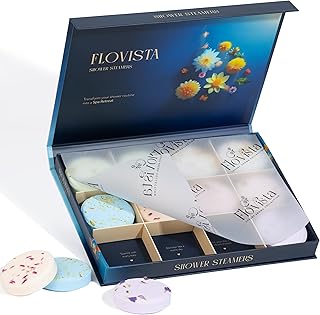
Premium shower steamers — eucalyptus, peppermint, lavender, and menthol varieties for the perfect aromatherapy shower experience.
Shop Shower Steamers on Amazon
🌫️ Shower Steamers
Can You Use a Shower Steamer in the Bath (or Bathtub)?
⚠️
Not Recommended — Skin Irritation Risk
Shower steamers should not be dissolved in bathwater for soaking. They contain much higher concentrations of essential oils, menthol, and fragrance than your skin should be in prolonged contact with — especially in sensitive areas.
The instinct makes sense — shower steamers fizz like bath bombs, they’re a similar size, and they smell wonderful. But placing one in a full bath and soaking in it is one of the most common bath product mistakes people make, and it can cause real discomfort.
Shower steamers are formulated for inhalation, not immersion. The essential oil concentrations — particularly menthol, eucalyptus, peppermint, and camphor that are common in shower steamers — are calibrated for airborne aromatherapy, where they get heavily diluted into the steam of an entire shower space before being inhaled. When dissolved in a bathtub and applied directly to skin for 20 minutes, these same concentrations can cause:
- Skin tingling or burning, particularly in the bikini area, underarms, and any broken or sensitive skin
- Mucous membrane irritation — menthol and eucalyptus at bath-concentration can be uncomfortable in intimate areas
- Eye irritation from steam rising off a menthol-concentrated bath
- Potential rashes or contact dermatitis in those with essential oil sensitivities
💡 Safe Alternative: Steam Fragrance Method
If you want the aromatherapy effect of a shower steamer while taking a bath, place the steamer at the edge of the tub where it will get splashed and partially activated but not fully submerged. Or simply run the hot shower for 2–3 minutes with the steamer on the shower floor to fill the bathroom with steam and fragrance before drawing your bath. You get the aromatherapy; your bathwater stays skin-safe.
Can You Use Shower Steamers Like a Bath Bomb (or As a Bath Bomb)?
🚫
No — They Are Not Interchangeable
Shower steamers should not be used as bath bomb substitutes for soaking. The high essential oil and menthol concentrations formulated for airborne aromatherapy are too concentrated for direct skin contact in a bath.
This question gets asked constantly because the products look so similar and are sold in the same sections of stores and websites. But “can I drop this in my bath instead of a bath bomb?” has a firm answer: not safely, no.
The difference comes down entirely to formulation intent. Bath bombs are formulated as skin contact products. Every ingredient — the fragrance, the colorants, the oils, the salts — is selected and dosed at levels appropriate for 20 minutes of full-body skin immersion. Shower steamers are formulated as air diffusion products. Their ingredients are chosen and dosed for inhalation from a distance, not skin contact. Using them interchangeably applies bath-bomb logic to a shower-steamer formulation — and the fragrance and menthol concentrations simply aren’t safe for bathing.
✅ What Shower Steamers Can Do in Shower Context
- Fill an enclosed shower with therapeutic aromatherapy steam
- Provide eucalyptus/menthol respiratory relief (sinus, congestion)
- Create a spa-like sensory shower experience
- Work effectively in a small footwell basin as a foot steam
- Activate slowly on a corner shelf away from direct spray
❌ What Shower Steamers Should NOT Do
- Be dissolved in a bath for soaking
- Be rubbed directly onto skin
- Be held in hands for prolonged contact
- Be used in a children’s bath (menthol concentration)
- Be used as a full bath bomb substitute
How Shower Steamers Actually Work (and Why Placement Matters)
Understanding the mechanics of shower steamers helps you get dramatically more from them — and explains why most people are using them suboptimally.
A shower steamer contains the same citric acid and baking soda base as a bath bomb. When water hits it, they react and release CO₂, which creates the fizzing. But unlike a bath bomb, the fizzing serves a mechanical function: it propels the essential oils into the air as microdroplets and vapor. The menthol, eucalyptus, or lavender doesn’t just evaporate passively — the fizzing reaction actively disperses it into the steamy air of the shower enclosure.
Optimal Placement for Maximum Effect
✅ Best: Corner of Shower Floor
Away from direct spray but in an area where steam and water splashes will gradually activate it. The steamer lasts longer and the aromatherapy effect is sustained for the entire shower. This is how most manufacturers intend them to be used.
✅ Good: Shower Shelf Away from Spray
A caddy shelf just outside direct water flow. Steam from the shower activates it slowly; you can also briefly run water over it at the start of the shower for an initial burst of fragrance. Clean-up is easier as it doesn’t touch the floor.
⚠️ Avoid: Directly Under Spray
Direct spray dissolves the steamer in minutes rather than the 15–20 minutes it’s designed to last. You get an intense 2-minute burst and then nothing for the rest of the shower. Wasteful and dramatically reduces the aromatherapy duration.
⚠️ Avoid: Directly on Drain
The fizzing reaction can temporarily block the drain with the dissolving material, and the product washes away fastest in this position. The undissolved ingredients go straight down the drain rather than into the steam air.
💡 Make Your Steamer Last Longer
Store shower steamers in an airtight container between uses — humidity in the bathroom gradually activates them even when not in the shower, depleting the fizzing power. A ziplock bag or glass jar with a lid preserves them for their full advertised duration. Steamers left loose on a bathroom shelf in humid climates can lose 30–50% of their potency within weeks.

True bath bombs formulated for skin contact — shea butter, coconut oil, Epsom salts, and skin-safe fragrance concentrations. The real thing for a proper bath.
Shop Bath Bombs on Amazon
🧂 Bath Salts
Can You Use Bath Salts in the Shower?
✅
Yes — With a Different Application Method
Absolutely. Bath salts work well in the shower — they just need to be applied directly to the skin as a scrub rather than dissolved in standing water. You get all the exfoliating and mineral benefits, sometimes more effectively than in a bath.
Bath salts are typically Epsom salt (magnesium sulfate), Dead Sea salt, Himalayan pink salt, or a blend — often with added essential oils, colorants, and botanical extracts. In a bath, their benefits come through two mechanisms: osmotic mineral absorption (debated but popular) and exfoliation. In a shower, you can replicate both — particularly the exfoliation, which may actually work better in a shower than a bath.
Here’s the logic: in a bathtub, bath salts dissolve into the water and the exfoliating grains are no longer in contact with your skin. The “scrubbing” effect diminishes once they’ve dissolved. In a shower, you apply undissolved or barely-dissolved salts directly to your skin and manually exfoliate — the abrasive action is direct, controlled, and far more effective for removing dead skin cells than passive soaking. The warm shower water then rinses everything off cleanly.
What You Get From Bath Salts in the Shower
✨ Exfoliation
The coarser the salt grain, the more abrasive the exfoliation. Himalayan pink salt and coarse Dead Sea salt provide significant mechanical exfoliation — effectively removing dead skin cells. Use a gentle circular motion on arms, legs, and torso. Avoid the face and any broken or irritated skin.
🌿 Aromatherapy
Bath salts with added essential oils release their fragrance beautifully in a hot shower. The steam carries the aromatics efficiently, and the warm water activates the scent more effectively than cold water would. Lavender, eucalyptus, and peppermint bath salts make excellent shower scrubs for this reason.
💧 Mineral Contact
The debate about transdermal magnesium absorption from Epsom salts continues in scientific literature. What’s agreed on: dissolved minerals in warm water do contact the skin’s outer layers. A shower scrub leaves dissolved salt residue on the skin for the duration of the shower — providing at least as much mineral contact as a bath that dilutes the same salts in 50+ gallons of water.
🛁 Foot Soak
The most effective bath salt use in a shower context: fill a shallow basin with warm water, dissolve a generous amount of bath salts, and rest your feet in it while the rest of you showers normally. A foot soak using bath salts softens calluses, reduces foot odor, and provides genuine mineral soak time where soaking is most practical.
How to Use Bath Salts in the Shower: Step-by-Step
- Start with a warm shower to open pores and soften the skin surface — this makes exfoliation more effective and less abrasive.
- Take a small handful of bath salts in your palm (about 1–2 tablespoons). If the salts have added oils, they’ll clump nicely; if dry, add a few drops of water to your palm first.
- Apply in gentle circular motions — start with legs, move to arms, then torso. Use light pressure on thinner-skinned areas (inner arm, décolletage) and firmer pressure on thicker areas (heels, knees, elbows). Always avoid the face, neck, and any irritated or broken skin.
- Let it sit for 30–60 seconds on each area before rinsing — this allows any added essential oils to make skin contact.
- Rinse thoroughly with warm water, then turn the water to cool for the final 30 seconds — this closes pores after the warm exfoliation.
- Apply body lotion or oil immediately after while skin is still slightly damp — freshly exfoliated skin absorbs moisturizer more effectively than any other time.
⚠️ Drain Warning
Bath salts used as a shower scrub will partly dissolve and flow down your drain. Coarser, undissolved salt particles can accumulate in the drain trap over time. Flush with hot water after salt scrub use and check your drain regularly if you use bath salts frequently in the shower. This applies particularly to shower drains without deep traps — the salt residue can also make the shower floor briefly slippery after use.

Dead Sea salt and Epsom salt scrubs — work perfectly in the shower as a body exfoliant and in the bath for soaking. The most versatile bath product you can own.
Shop Bath Salts on Amazon
🫒 Body Oil
Can You Use Body Oil in the Shower?
✅
Yes — and It May Be More Effective Than After-Shower Application
Using body oil in the shower — specifically on damp skin before you’ve fully dried — allows the oil to lock in the water moisture your skin has absorbed, producing significantly better hydration than applying oil to completely dry skin.
The science behind in-shower body oil use is straightforward: your skin absorbs water while you shower, temporarily increasing its hydration at the surface level. If you apply body oil immediately while skin is still damp (in the shower or directly as you step out), the oil forms a semi-permeable barrier over the moisture-plumped skin, slowing water evaporation and “locking in” the hydration. This is the principle behind the growing “wet skin moisturizing” trend, and it genuinely works — dermatologists recommend it for dry skin conditions including eczema and psoriasis.
Many “dry body oils” and “shower oils” are specifically marketed for in-shower use — they’re formulated with quick-absorbing carrier oils (jojoba, squalane, fractionated coconut oil) that absorb before you rinse rather than making you feel greasy post-shower. Traditional thicker body oils (argan, rosehip, sweet almond) also work in the shower but are better applied just as you step out onto the bath mat rather than rinsed under running water.
Two Different In-Shower Oil Methods
Method 1: Apply, Leave, Rinse Lightly
Apply oil to damp skin mid-shower. Massage in for 30–60 seconds, let sit another minute, then step out of direct spray but don’t fully rinse. Pat dry gently. Best for dry body oils and lightweight formulas. Leaves a subtle sheen without greasiness.
Method 2: Apply as You Step Out
Turn off the shower but don’t dry fully. While skin is still wet, apply body oil and massage it in. The oil mixes with the surface water and absorbs more evenly than on dry skin. Best for richer oils like argan or sweet almond. Most recommended method by dermatologists.
⚠️ Slippery Shower Floor — Critical Safety Point
Body oil in the shower creates a genuinely dangerous slipping hazard. Any oil that drips, splashes, or runs onto the shower floor makes it significantly more slippery. If you use body oil in the shower: apply it while seated on a shower bench or after stepping onto a non-slip bath mat; keep the oil away from the shower floor by applying it at waist height or above; rinse the shower floor thoroughly with hot water after use. This is not an optional caution — oil on a wet shower floor is a serious fall risk.
The Best Body Oils for Shower Use
🌿 Jojoba Oil
Technically a liquid wax, not an oil. Closely matches the composition of human sebum. Absorbs extremely quickly without residue — ideal for in-shower use because it doesn’t make the floor slippery and absorbs before most of it rinses away. Non-comedogenic and suitable for all skin types.
🪸 Squalane
A stable, lightweight oil derived from olives or sugarcane. Highly regarded by dermatologists for moisturizing dry and sensitive skin. Absorbs fast, is odorless, and leaves no greasy film. One of the best choices for the immediate-post-shower wet skin application method.
🌸 Rosehip Oil
Rich in vitamin A and vitamin C, with skin-brightening and anti-aging properties. Absorbs in 5–10 minutes on damp skin. Best applied as you step out of the shower rather than under running water, as its active compounds are more preserved with minimal water contact.
🥥 Fractionated Coconut Oil
Unlike regular coconut oil (solid at room temperature), fractionated coconut oil is liquid, odorless, and lightweight. Excellent in-shower moisturizer. Regular coconut oil can also work for the post-shower damp-skin method but may turn solid on cooler shower walls — keep in a warm location.
🌾 Sweet Almond Oil
A mid-weight, softly scented oil beloved for body moisturizing. Takes slightly longer to absorb than jojoba or squalane, making it better for the step-out-damp method than in-shower application. Particularly effective for dry, rough skin on elbows, knees, and heels.
🫒 Argan Oil
The premium choice. Rich in vitamin E and fatty acids with proven skin barrier-repair properties. Use sparingly — a small amount goes a long way. Best for the step-out-damp method applied to slightly towel-patted (not fully dry) skin. Works particularly well on arms and legs for lasting smoothness.

Lightweight body oils formulated for in-shower and post-shower use — fast-absorbing, non-greasy, and safe for shower-floor-conscious application.
Shop Body Oils on Amazon
💎 Quartz in the Shower
Can You Use Quartz in a Shower?
✅
Yes — Engineered Quartz Is Excellent for Showers
Engineered quartz (like Silestone or Cambria) is one of the best materials for shower walls and surrounds — non-porous, highly durable, and easy to maintain. Natural quartz crystals used decoratively are a different matter entirely.
The word “quartz” covers very different things in the shower context, and the answer changes completely depending on which you mean:
🏗️
Engineered Quartz Slabs / Tiles
Silestone, Caesarstone, Cambria, Quartz composite panels — non-porous, highly water-resistant, stain-proof, and durable. Excellent for shower walls, shower niches, and shower floors (with appropriate texture/treatment). One of the top-tier shower wall materials available.
⚠️
Natural Quartzite Stone
A natural stone (not the same as quartz composite). Some quartzite is suitable for showers after proper sealing; some is too porous. Requires annual or biannual re-sealing and more careful maintenance than engineered quartz. Consult your stone supplier about suitability for wet areas.
🔮
Decorative Crystal Quartz (Rose Quartz, Amethyst, etc.)
Crystals and gemstones should generally NOT be placed in the shower. Many dissolve, crack, or lose their polish in water. Hard varieties (quartz, amethyst) may survive, but most crystal accessories are damaged by prolonged water exposure and soap chemicals. Keep crystals out of the shower.
Engineered Quartz vs Natural Quartzite in Showers: Full Comparison
| Property | Engineered Quartz | Natural Quartzite | Porcelain Tile (for reference) |
|---|
| Porosity |
Non-porous |
Low to moderate (needs sealing) |
Non-porous (through-body) |
| Water resistance |
Excellent |
Good when sealed |
Excellent |
| Stain resistance |
Excellent — won’t absorb soap scum |
Good when sealed; needs maintenance |
Excellent |
| Mold / mildew risk |
Very low — no pores for growth |
Moderate — pores trap moisture if unsealed |
Low (grout lines are the risk, not tile) |
| Required sealing |
None |
Yes — annually or biannually |
Grout only |
| Scratch resistance |
Very high (Mohs 7) |
Very high (Mohs 7) |
High (glazed) |
| Heat resistance |
Moderate — avoid prolonged high heat |
Excellent |
Excellent |
| Cleaning ease |
Very easy — mild cleaner only |
Medium — avoid acidic cleaners |
Easy |
| Cost (installed) |
$70–$120/sq ft |
$60–$130/sq ft |
$15–$60/sq ft |
💎 Why Engineered Quartz Is Ideal for Showers
Engineered quartz (approximately 93% ground quartz bound with polymer resins) is manufactured to be non-porous — there are no microscopic pores for water, bacteria, mold, or soap residue to penetrate. It never needs sealing, doesn’t etch with acidic cleaners the way natural stone does, and maintains its appearance indefinitely with basic cleaning. The seams and grout lines remain the primary maintenance focus (as with all shower materials), but the quartz panels themselves are essentially maintenance-free. It’s also significantly more consistent in appearance than natural stone — each slab looks very close to the showroom sample, unlike natural stone that can vary significantly between slabs.
How to Care for Quartz in the Shower
Engineered quartz in a shower requires significantly less maintenance than natural stone but has a few specific product cautions that owners frequently violate, causing premature dullness or surface damage.
✅ Safe Cleaners for Quartz
Mild dish soap and warm water for daily wiping. pH-neutral stone or quartz-specific cleaners for weekly cleaning. Non-abrasive cream cleaners for stubborn soap scum. A soft microfiber cloth — never scrubbing pads. Rinse completely to prevent soap residue buildup.
❌ What to Avoid on Quartz
Avoid: bleach (damages the resin binder over time), abrasive scrubbing pads, vinegar and citrus-based cleaners (acidic and damaging), heavy-duty bathroom cleaners with harsh chemicals, and steam cleaners held too close (the resin can be affected by prolonged direct steam). These don’t destroy quartz immediately but cause cumulative surface degradation over months and years.
Full Comparison: Can You Use It In/For…
| Product | In the Bath? | In the Shower? | Key Limitation |
|---|
| Bath Bomb |
✅ Designed for it |
⚠️ Limited benefit |
Needs soaking time — most benefits wash away immediately in shower |
| Shower Steamer |
❌ Not recommended |
✅ Designed for it |
Too concentrated for skin contact — designed for inhalation only |
| Bath Salts |
✅ Designed for it |
✅ Works well |
In shower: apply as scrub, not dissolved in water. Slippery floor risk. |
| Body Oil |
✅ Works well |
✅ Works well (often better) |
Serious slippery floor risk. Apply at waist height, never on floor. |
| Engineered Quartz |
N/A (construction material) |
✅ Excellent choice |
Avoid bleach and acidic cleaners. No sealing required. |
| Natural Quartzite |
N/A |
⚠️ Yes, if properly sealed |
Requires annual sealing. Porous if unsealed. |
| Crystal/Decorative Quartz |
❌ Not recommended |
❌ Not recommended |
Most crystals degrade, dissolve, or lose polish in water and soap |
Frequently Asked Questions
Can you use a bath bomb in the shower instead of a bath?
Yes, but most of the skin benefits are lost. Bath bombs need soaking time to transfer oils and minerals to skin — in a shower, they mostly wash straight down the drain. The fragrance works well in shower steam, making this the most useful application. Best method in a shower: place on the floor away from direct spray for a slow, fragrance-releasing experience, or use as a body scrub by rubbing on damp skin before rinsing.
Can you use a shower steamer in the bath?
Not recommended. Shower steamers contain 3–5× the essential oil concentration of bath bombs and are formulated for inhalation, not skin contact. Dissolving one in bathwater and soaking in it can cause skin irritation, particularly menthol and eucalyptus burning in sensitive areas. To get aromatherapy benefits while bathing, run the shower briefly with a steamer on the floor to fill the bathroom with steam first.
Can you use shower steamers as bath bombs?
No — they’re not interchangeable. Bath bombs are skin contact products formulated for soaking; shower steamers are air diffusion products formulated for inhalation. The essential oil concentration in shower steamers is too high for safe prolonged skin contact in a bath. Use each product for its intended purpose for both safety and optimal results.
Can you use bath salts in the shower?
Yes, very effectively. Apply bath salts directly to damp skin as a scrub using gentle circular motions. You get full exfoliation benefits — often better than in a bath because the abrasive action is direct rather than dissolved in tub water. Rinse thoroughly and be aware that salts can make the shower floor slightly slippery.
Can you use body oil in the shower?
Yes — applying body oil to damp skin in the shower (or immediately as you step out) locks in shower-absorbed moisture more effectively than applying to completely dry skin. Use lightweight, fast-absorbing oils like jojoba or squalane for best results. Always be aware of the slippery floor risk — apply oil at waist height or above, never directly on the floor.
Can you use quartz in a shower?
Engineered quartz (Silestone, Caesarstone, Cambria) is an excellent shower material — non-porous, no sealing required, easy to clean, and highly durable. Natural quartzite works in showers but requires proper sealing and more maintenance. Decorative crystal quartz should not be placed in the shower as most crystals are damaged by prolonged water and soap exposure.
Why can’t you use a shower steamer in the bathtub?
The fragrance oil and menthol concentration in shower steamers is formulated for airborne delivery — they need to fill an entire steam shower space before being inhaled from a distance. When dissolved in bathwater, that same concentration is in direct contact with all your skin for 20+ minutes, which can cause burning, tingling, and irritation, particularly in sensitive areas. The product works beautifully in the shower precisely because the steam dilutes it significantly before it reaches you.
How do you use shower steamers correctly?
Place the steamer in a corner of the shower floor or on a shelf away from direct spray. Steam and occasional water splashes will gradually activate it over 15–20 minutes. Avoid placing directly under the shower head (dissolves too fast) or on the drain (washes away). Store unused steamers in an airtight container to prevent humidity from prematurely degrading them.
Does quartz need to be sealed in a shower?
Engineered quartz does not need sealing — it’s manufactured as a non-porous material. Natural quartzite (a different material often confused with engineered quartz) does need sealing annually or biannually. When in doubt, ask your supplier whether your material is engineered quartz composite or natural quartzite — the care requirements are completely different.
What’s the best way to use a bath bomb in the shower for maximum benefit?
The foot soak method: fill a shallow basin with warm water, dissolve the bath bomb in it, and soak your feet while showering normally above. You get full bath bomb skin-contact benefits for your feet. Alternatively, rub the bomb directly on damp skin as a moisturizing body treatment before rinsing — the oils and butters make direct skin contact before washing away. Placing it on the shower floor away from direct spray releases the fragrance into the steam for an aromatherapy experience.
The Bottom Line: Know What Your Products Are Designed For
Every question in this guide comes back to one principle: use products for their intended environment, and understand why before you deviate. Bath bombs need soaking. Shower steamers need steam space. Bath salts adapt beautifully between both contexts. Body oil works better in the shower than most people realize. And engineered quartz is one of the best shower wall decisions you can make.
Bookmark this guide the next time a bathroom product question comes up — and share it with anyone who’s been wondering whether they can mix and match their bath and shower essentials.
Explore More Shower Guides →