Whether you’ve just walked out of a tattoo studio, a spray tan booth, a waxing salon, or left the hospital after shoulder surgery — the first question is almost always the same: when can I shower? The answer varies enormously from 2 hours to 6 weeks depending on what you had done and why water exposure matters for that specific treatment.
This guide covers every major treatment with exact timelines, the science behind each wait, and what happens if you shower too soon — so you can make an informed decision rather than guessing.
All Wait Times at a Glance
| Treatment | Minimum Wait | Recommended Wait | What to Avoid Longer |
|---|
| New Tattoo (any location) |
2–4 hrs |
24 hrs for hot shower |
Baths / pools / soaking: 2–4 weeks |
| Back Tattoo |
2–4 hrs |
Same as any tattoo; technique differs |
Soaking: 3–4 weeks |
| Spray Tan (standard DHA) |
4–6 hrs |
8–12 hrs (overnight best) |
Hot water / scrubbing shortens fade |
| Spray Tan (rapid/express) |
1–3 hrs |
Per technician instruction |
Same aftercare applies |
| Brazilian Wax |
4–6 hrs |
24 hrs (no hot shower) |
Hot baths / steam: 48 hrs |
| Body Wax (legs, arms) |
2–4 hrs |
12–24 hrs (lukewarm only) |
Hot water on waxed area: 24 hrs |
| Eyebrow Wax |
2–4 hrs |
24 hrs (keep brows dry) |
Hot steam on face: 24–48 hrs |
| Tanning Bed |
Immediately OK |
Wait if using bronzer lotion |
Hot / long showers fade tan faster |
| Lash Lift |
24 hrs |
24–48 hrs (no moisture at all) |
Steam / swimming: 48 hrs |
| Henna |
6–8 hrs (paste on) |
12–24 hrs (avoid water) |
Soap on design: deepens color if avoided |
| Pedicure (regular polish) |
2 hrs |
4–6 hrs (fully cured) |
Prolonged hot soak shortens polish life |
| Pedicure (gel polish) |
Immediately |
No wait needed — UV-cured |
— |
| Shoulder Surgery |
48–72 hrs |
7–14 days (surgeon-guided) |
Full shoulder immersion: 4–6 weeks |
How Long After a Tattoo Can I Shower? (Including Back Tattoos)
3–4
hours
Minimum Wait — Brief Lukewarm Shower
Most tattoo artists recommend waiting 3–5 hours before your first shower. If your tattoo is wrapped in plastic cling wrap, remove it after 2–4 hours and then shower. If it’s covered in Saniderm or a second-skin bandage, you can shower with it on immediately.
A fresh tattoo is an open wound — a pattern of thousands of tiny needle punctures filled with ink. In the first few hours, it weeps plasma, blood, and excess ink as the healing process begins. Showering too soon (within the first 2 hours) isn’t catastrophic, but it introduces unnecessary bacteria to a fresh wound and can pull out partially-set ink. Most artists advise waiting 3–5 hours from session completion before your first shower.
The Back Tattoo Difference
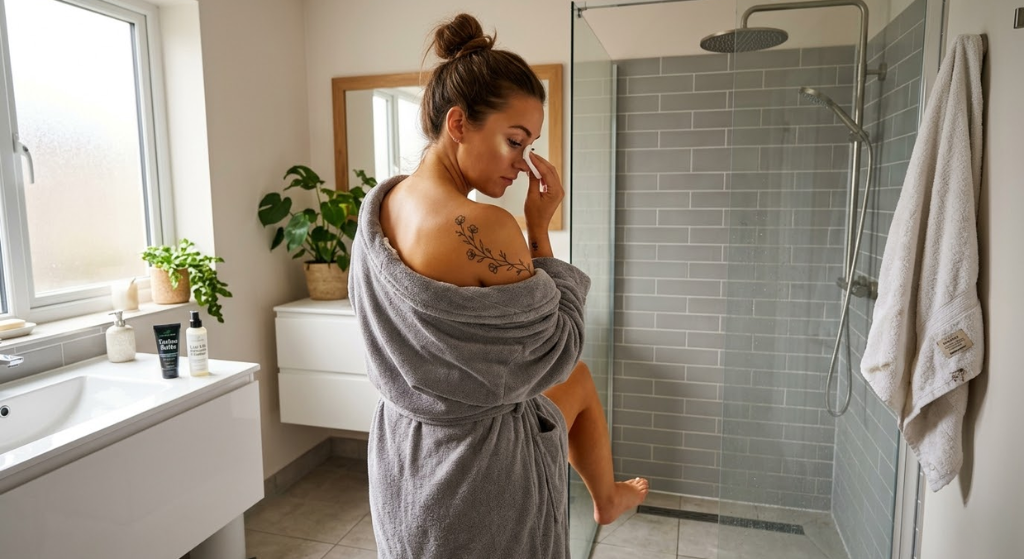
A back tattoo follows the same timing rules as any other tattoo — the wait is not longer because of the location. However, the practical challenge of showering with a back tattoo is different: you cannot easily see or control the water pressure hitting the tattooed area. The skin on the back is relatively tough and tolerates shower water well, but avoid direct high-pressure spray on the fresh tattoo during the first week. Turn your back away from the shower head and let water flow over the area gently rather than blasting it directly.
Many back tattoos cover large surface areas, which means more weeping plasma in the first 48 hours and more surface area to keep clean. A gentle rinse once or twice daily during the healing period (days 1–14) is actually recommended to prevent plasma and ink accumulating into hard scabs that can crack and pull ink when they fall off.
No shower
Brief lukewarm
Gentle shower OK
Normal shower
Full routine
04 hrs24 hrs1 wk2–4 wks
Complete Tattoo Shower Rules
✅ What to Do When You Shower
Use lukewarm (not hot) water on the tattoo. Wash gently with a fragrance-free, antibacterial liquid soap — use your fingertips, not a washcloth or loofah. Rinse thoroughly. Pat completely dry with a clean paper towel or freshly laundered soft cloth — never rub. Apply aftercare ointment (Aquaphor, Hustle Butter, or your artist’s recommendation) while skin is still slightly warm.
❌ What to Avoid
No hot water (opens pores and pulls ink). No high-pressure spray directly on the tattoo. No soaking — baths, hot tubs, swimming pools, or ocean for 2–4 weeks. No scrubbing, no washcloth, no loofah. No products with fragrance, alcohol, or harsh chemicals on the healing area. No picking or rubbing scabs in the shower.
🩹 If You Have Saniderm/Second Skin
Shower immediately — Saniderm and all second-skin bandages are 100% waterproof. You can shower normally with the bandage on. Remove it under warm running water after the period your artist specified (typically 3–5 days). The warm water loosens the adhesive and makes removal painless.
⏱️ How Long Should the Shower Be?
Keep it to 5–10 minutes during the first week of healing — just long enough to wash the tattoo gently and rinse. Extended hot showers soften the healing skin and can cause scabs to fall off prematurely. Shorter, cooler showers produce significantly better healed results in dark detail work and color tattoos.
⚠️ Why Soaking Is Different From Showering
There’s an important distinction between showering over a tattoo (brief water exposure, rinsed off) and soaking (prolonged submersion in standing water). Showering after a few hours is generally safe and hygienic. Soaking in a bath, pool, hot tub, or sea water is not safe for 2–4 weeks after getting tattooed. Soaking softens and separates the healing skin layers, washes out ink that hasn’t fully set, and exposes open tissue to bacteria, chlorine, and saltwater that cause infection and patchy healing.
How Long After a Spray Tan Should You Shower?
8–12
hours
Recommended Wait for Standard DHA Tans
For a standard spray tan, wait 8–12 hours before your first shower — overnight is ideal. Express/rapid tans have shorter windows of 1–4 hours as directed by your technician. The exact time depends on the DHA concentration in your specific tan.
The spray tan wait time is the question that trips up more people than almost any other beauty timing question — because there are now multiple categories of spray tan product, and the rules differ significantly between them.
Why the Wait Time Matters: The DHA Reaction
DHA (dihydroxyacetone) is the active ingredient in all spray tans. It’s a colorless sugar that reacts with amino acids in the outermost layer of your skin (the stratum corneum) through a chemical process called the Maillard reaction — the same browning process responsible for bread crust and caramelized sugar. This reaction develops gradually over 4–12 hours after application.
When you shower before the DHA reaction is complete, you rinse away the unreacted DHA before it has fully bound with your skin proteins. The result is a lighter tan than expected, often patchy — some areas where the reaction completed are darker, others where it was interrupted are lighter. That patchiness is the main consequence of showering too soon.
No shower
Reaction developing
Almost ready
Reaction complete — shower OK
02 hrs4–6 hrs8–12 hrs
🕐 Standard Spray Tan
Wait 8–12 hours minimum; overnight (10–12 hours) is ideal. The tan you see immediately after application is a cosmetic bronzer guide coat, not the actual DHA tan — it washes off in the first shower. The real tan underneath develops over 8–12 hours and continues deepening for up to 24 hours after your first rinse.
⚡ Express / Rapid Tan
Express tans use higher DHA concentrations that react faster — typically 1–4 hours depending on product and desired depth. Your technician will specify exactly when to shower: “1 hour for light, 2 hours for medium, 3 hours for dark.” Do not exceed the maximum time or the tan becomes too dark and streaky.
🚿 The First Shower
Your first post-tan shower will appear alarming — a lot of brown color washes off. This is the cosmetic bronzer guide coat, not your tan. The actual DHA tan remains on your skin underneath. Use lukewarm water (hot water fades tans faster), no soap on the tan areas — just water-only rinse. Pat dry gently, no rubbing.
📅 Making It Last
After the first rinse, the longevity of your spray tan depends significantly on your shower habits. Short, cool showers preserve it longest. Hot, long showers accelerate exfoliation of the outer skin layer where the DHA color lives. Avoid exfoliating soaps, loofahs, or scrubs on tanned areas. Moisturize daily on damp skin after every shower.
💡 The Overnight Strategy
The most reliable approach to spray tanning: get your tan in the late afternoon or early evening, do not shower before bed, and take your first shower the following morning after 10–12 hours. This guarantees full DHA reaction time regardless of product concentration, eliminates the guesswork around “is it ready,” and produces the most even, deepest result from a standard tan.
How Long After a Wax Can You Shower? (Brazilian and Body Wax)
24
hours
Wait Before Hot Shower — Lukewarm OK After 4–6 Hours
A cool or lukewarm shower is acceptable 4–6 hours after waxing. A hot shower, steam, or bath should be avoided for 24 hours after a Brazilian wax and 12–24 hours after body waxing. The first 24 hours are the critical protection window.
Waxing removes hair at the follicle root, simultaneously pulling out the hair shaft and temporarily lifting the protective cells around each follicle opening. Those follicles stay open and vulnerable to heat, bacteria, and friction for 24–48 hours after waxing — this is the window that matters.
Hot water in this window causes vasodilation, increasing blood flow to already-inflamed follicles. This intensifies the redness and sensitivity, and can trigger folliculitis — inflammation of the hair follicles that manifests as small red bumps. Steam in an enclosed shower is especially problematic because it combines heat with humidity that can introduce bacteria to open follicles. The Brazilian wax area is most sensitive because the skin in the bikini zone is thinner and the follicle density is higher than most other waxed areas.
The Safe Wax Shower Timeline
- 0–4 hours: No shower at all if possible. Gently pat with a cool, clean cloth if needed. Do not apply any products other than a soothing, alcohol-free aloe gel.
- 4–24 hours: Brief, lukewarm shower acceptable. Keep water temperature cool to moderate. Avoid directing the shower spray at high pressure onto the waxed areas. Fragrance-free, gentle cleanser only.
- 24–48 hours: Warm showers are fine. Avoid hot baths, steam rooms, or hot tubs.
- After 48 hours: Return to normal shower routine. Begin gentle exfoliation 3–5 days post-wax to prevent ingrown hairs.
⚠️ Also Avoid After Waxing
In addition to hot showers: avoid tight clothing against freshly waxed skin (friction + heat creates ideal conditions for folliculitis); no deodorant or antiperspirant in the underarm area for 24 hours; no sun exposure on freshly waxed skin for 24 hours; no swimming pools or the ocean for 24 hours (chlorine and saltwater both irritate open follicles). Skip the gym for the day — sweat on open follicles is a direct infection vector.
How Long After an Eyebrow Wax Can I Shower?
2–4
hours
Minimum Wait — But Keep Face Away From Hot Steam
You can shower 2–4 hours after an eyebrow wax, but avoid direct hot water or steam on the brow area for 24 hours. The facial skin is more sensitive than body skin and the brow area has just had follicles opened by the wax.
An eyebrow wax is less extensive than a Brazilian or full body wax, but the facial skin is notably more reactive — it’s thinner, more vascular, and has a higher concentration of nerve endings than most body skin. The follicles opened by eyebrow waxing are exposed to the same risks as any waxed area, with the added dimension that the face is unavoidably exposed to facial steam in the shower.
The practical guidance: a normal shower is fine 2–4 hours after an eyebrow wax as long as you tilt your face away from the direct shower stream and avoid prolonged hot steam on your face. Face wash applied with fingertips (not a washcloth) is acceptable. The main caution is hot steam and high-pressure water directly on the freshly waxed brow ridge, which can cause redness, irritation, or breakouts in the follicle area.
💡 The 24-Hour No-Makeup Rule Also Applies
Most brow technicians advise no makeup on the brow area for 24 hours post-wax — not just because of the follicle irritation risk, but because makeup products applied to open follicles can cause comedonal breakouts (blocked pore bumps) in the brow area. After your safe-timing shower, keep the brow area free of products for the first 24 hours.
How Long After the Tanning Bed Can I Shower?
2–3
hours
If You Used Tanning Lotion With Bronzer or DHA
If you tanned with no product or cosmetic bronzer only, you can shower shortly after. If you used a lotion containing DHA (self-tanning component), wait 2–4 hours. The UV tan itself is not affected by showering — only applied products are.
The timing question for tanning bed showering comes down to one variable: did you use a tanning product containing DHA?
The UV-induced melanin tan from a tanning bed happens at the cellular level — UV radiation triggers melanocytes (pigment cells) to produce melanin, which darkens the skin. This process is entirely internal and continues developing for 2–4 hours after UV exposure ends. No amount of showering stops or reverses it. You cannot “wash off” a UV tan.
What you can wash off prematurely is a DHA-based self-tanning ingredient if your tanning lotion contained one. Many tanning accelerator and bronzer lotions include DHA alongside the cosmetic bronzer, so that the tan continues developing after you leave the salon. These products follow the same shower timing as a spray tan: wait 2–4 hours minimum for DHA to complete its reaction with your skin before rinsing.
How Long After the Tanning Bed Does It Show?
The visible UV tan from a tanning bed typically begins appearing 2–4 hours after the session as the melanin oxidizes and darkens. The tan continues developing and deepening for up to 24–48 hours post-session as the melanin production cycle completes. This is why people often feel they look the same immediately leaving a salon but noticeably darker the next morning — the tan was developing overnight.
The initial redness seen immediately after UV exposure is a vascular response (blood flow to the skin surface) rather than tan color — it subsides within a few hours, and the actual tan color develops beneath it. If you shower too soon after a session with a DHA bronzer lotion, you’ll rinse away the cosmetic guide color and may not see your full color development until the DHA reacts, which creates a period of looking temporarily lighter than expected.
☀️ Maximizing Tanning Bed Tan Longevity
A UV tan fades as the outer skin cells exfoliate and are replaced by new cells from beneath. Showering habits significantly affect how long it lasts: cool, short showers strip fewer skin cells than long hot showers; gentle cleansers preserve the tan longer than exfoliating or antibacterial soaps; moisturizing immediately on damp post-shower skin is the most effective way to slow exfoliation and extend tan duration. A well-maintained UV tan lasts 7–10 days; without moisturizing, closer to 5–7 days.
How Long After a Lash Lift Can I Shower?
24
hours
No Moisture of Any Kind for 24 Hours — 48 Hours Ideal
Wait a full 24 hours before showering after a lash lift. Keep your eyes and lashes completely dry — no steam, no humidity, no water near the eye area. 48 hours is the gold standard recommended by most lash technicians for longest-lasting results.
A lash lift uses a chemical perm process — a lifting solution breaks the disulfide bonds in the lash hair proteins, the lashes are shaped around a silicone rod, and a setting solution reforms the bonds in the new lifted position. Water is the enemy of this freshly-set bond structure.
When water contacts freshly permed lashes within 24 hours, it partially re-dissolves the reformed disulfide bonds before they’ve fully stabilized. The lashes relax from their lifted position — often unevenly — producing a droopy, inconsistent lift that typically falls flat within days rather than lasting the expected 6–8 weeks. This is not a safety issue; it’s a results issue. The 24-hour wait is entirely about chemical bond stability, not wound healing.
What Counts as “Moisture” After a Lash Lift
- Showering (even if you try to avoid your face — steam reaches the lashes)
- Washing your face with any water
- Swimming or any pool/ocean/lake exposure
- Excessive sweating (intense exercise, sauna, steam room)
- Rain or humid outdoor environments
- Crying (advise against emotional films for 24 hours)
- Eye drops or any liquid eye products
💡 The 48-Hour Upgrade
While 24 hours is the commonly stated minimum, extending the wait to 48 hours produces measurably better lift retention. The chemical bonds that hold your lashes in their new position continue stabilizing for up to 48 hours after setting. Many lash technicians who see clients for repeat treatments notice that clients who consistently wait 48 hours have lifts that last 7–8 weeks; those who shower at the 24-hour mark average 5–6 weeks. The extra day of being careful about water is worth several additional weeks of perfect lashes.
⚠️ How to Shower Safely After the Wait Period
Even after the 24–48 hour protection period, be gentle with your lashes in the shower. Avoid rubbing the eye area, pointing the shower stream directly at your face, or using waterproof eye makeup that requires aggressive removal. The lifted position is permanent to the current lash growth cycle (6–8 weeks) but individual lash hairs become slightly more fragile after the chemical treatment, so mechanical stress in the shower should be minimized.
How Long After Henna Can I Shower?
8–12
hours
Keep Paste On as Long as Possible — Then Avoid Soap on Design
Leave henna paste on for at least 6–8 hours (overnight is ideal) before removing. After removing the paste, avoid water on the design for an additional 12–24 hours. When you do shower, avoid soap directly on the henna design to maximize color depth.
Henna works by the active dye molecule (lawsone) migrating from the paste into the protein structure of the outer skin cells, binding with the keratin layer. This is a gradual oxidation process that continues for up to 48 hours after the paste is removed — the color starts orange-red and darkens to a rich burgundy-brown as it oxidizes with air and skin contact.
The paste itself acts as a reservoir that continues releasing lawsone while it remains on the skin. The longer the paste stays on, the more dye migrates, and the darker and longer-lasting the design will be. Removing paste after 2 hours produces a lighter tan; leaving it overnight produces deep, dark color that can last 2–3 weeks.
The Henna Shower Timeline
- While paste is on (0–12 hrs): No water at all on the design. If the paste dries and flakes, apply a thin coat of a sugar-lemon sealant (most henna artists provide this) to keep it moist and adhered.
- Removing the paste: Scrape off with a butter knife or credit card edge — do not wash off with water. The initial color will appear orange; this deepens over 24–48 hours.
- First 12–24 hours post-paste removal: Avoid water on the design entirely if possible. If you must shower, use a waterproof barrier (Vaseline applied over the design) to minimize water contact.
- First shower after henna: Use water but no soap directly on the henna design. Soap accelerates the exfoliation of the outer skin layer where the lawsone is bound, fading the color faster. Water alone rinses without stripping.
- Ongoing care: Apply a balm (coconut oil, shea butter) to the design after every shower. The oil fills the gaps in the dry outer skin layer and preserves the lawsone-keratin bond against daily exfoliation.
🌿 Why Henna Darkens After Removal
The orange color immediately after paste removal is oxidized lawsone at its initial state. Over 24–48 hours, exposure to oxygen and body heat completes the oxidation process, deepening the color to its final warm burgundy-brown. The design you see on day three is the design’s true final color. Judging a fresh henna design by its immediate post-removal color is like judging a developing photograph before it’s finished processing.
How Long After a Pedicure Can I Shower?
2–6
hours
Depends on Polish Type — Gel = Immediately; Regular = 2+ Hours
Gel pedicures can be showered immediately — the polish is UV-cured to full hardness in the salon. Regular nail polish needs 2 hours minimum for surface drying, 6 hours for full cure. Hot, prolonged showers can soften and dent even cured regular polish.
The pedicure shower question depends almost entirely on whether your polish is traditional air-dried nail polish or gel polish.
💅 Regular Nail Polish
Air-dried nail polish follows a two-stage curing process: surface drying (touch-dry) occurs within 15–30 minutes; full through-dry hardness takes 2 hours. Showering within the first 2 hours risks dents and smudges from water pressure or towel contact. For best results wait 6 hours — this ensures the base coat, color coat, and top coat have all fully hardened through their entire depth.
💅 Gel Polish (UV-Cured)
Gel nail polish is cured to full polymer hardness by UV or LED light during the pedicure — there is no ongoing drying process after you leave the salon. Gel nails can be showered immediately without any risk of smudging, denting, or damage from water. Prolonged hot water does not soften properly applied gel polish.
🛁 The Hot Water Exception
Even fully cured regular nail polish is more vulnerable to chipping when repeatedly exposed to very hot water, which slightly softens the polymer. Long, hot showers after a pedicure aren’t dangerous to the polish but do shorten its lifespan. Lukewarm showers are better for making a regular pedicure last its full 1–2 weeks.
🧼 The Cuticle and Skin Care
Beyond the polish, a pedicure involves cuticle work and exfoliation that briefly sensitizes the skin around the nail bed. Avoid harsh scrubbing products on the toenails and cuticle area in the 24 hours after a pedicure, as the cuticle removal process leaves that tissue slightly more exposed than usual.
How Long After Shoulder Surgery Can I Shower?
48–72
hours min
Always Follow Your Surgeon’s Specific Instructions
Most shoulder surgery patients can take a modified shower 48–72 hours after surgery, keeping the incision area completely dry. Full shower resumption (with water on the shoulder) typically takes 7–14 days depending on incision closure and wound status.
🚨 Critical: Follow Your Surgeon’s Instructions First
The information below represents general guidance for typical shoulder surgery recovery. Your surgeon’s specific post-operative instructions supersede everything on this page. Shoulder surgery varies enormously — from minor arthroscopic procedures to total shoulder replacement — and each case has specific wound management protocols. Never shower after surgery without explicit clearance from your care team.
Shoulder surgery presents specific showering challenges because the arm and shoulder are difficult to keep dry while still bathing the rest of the body. The primary concern is protecting surgical incisions from water exposure before they’ve adequately sealed. Wet, macerated incision tissue is at significantly higher risk of infection and poor healing than properly protected dry wounds.
Typical Post-Surgical Shower Timeline
Days 1–3: No Shower
Most surgeons prohibit showering for 48–72 hours post-surgery. The surgical dressing should remain clean and dry during this period. Sponge bath the unaffected areas of the body carefully. Keep the surgical site completely covered and protected.
Days 3–7: Modified Shower
Once the surgeon approves a modified shower, the technique involves: waterproofing the surgical area with a plastic bag or commercial waterproof wound cover secured with medical tape; showering with the affected arm outside the direct water stream; and being extremely cautious about arm movement given post-surgical mobility restrictions and the risk of re-injury from reaching for things in the shower.
Week 1–2: Gradual Resumption
As staples or stitches are removed and the surgeon confirms incision closure, normal showering can resume — typically 7–14 days for arthroscopic procedures, longer for open surgery. Even after clearance, avoid direct high-pressure water on the healing incision for several additional weeks. Use a gentle, fragrance-free soap on the incision site.
Weeks 4–6: Full Normal
Most shoulder surgery patients can shower completely normally after 4–6 weeks. The mobility limitations from sling use, restricted range of motion during recovery, and the need for assistance with hair washing (cannot raise the arm) are the practical challenges, not the wound itself at this stage.
💡 Practical Shower Safety After Shoulder Surgery
The sling makes everything in the shower harder and less stable. Install a shower bench or seat — being seated eliminates the balance challenge of single-arm showering. Use a handheld shower head to direct water without arm movement. Non-slip bath mat. Have someone nearby for the first several showers. A shower chair with arms provides the most secure seated showering option for post-surgical recovery.
Frequently Asked Questions
How long after a back tattoo can I shower?
The same as any tattoo — wait 3–5 hours before your first shower, and keep it brief, lukewarm, and gentle. A back tattoo doesn’t require a longer wait. The practical difference is technique: turn your back away from direct spray rather than letting high-pressure water blast the fresh tattoo. If covered in Saniderm, shower immediately — the bandage is waterproof.
How long after a Brazilian wax can you shower?
Wait 4–6 hours for a brief, cool or lukewarm shower. Avoid hot showers, steam, and hot baths for 24 hours after a Brazilian wax. The follicles in the bikini area are opened by waxing and remain vulnerable to heat, bacteria, and irritation for 24–48 hours post-treatment.
How long after a lash lift can I shower?
Wait a minimum of 24 hours — 48 hours is strongly recommended for best results. Any moisture (including shower steam) within this window can partially dissolve the newly reformed bonds that hold your lashes in their lifted position, causing the lift to drop prematurely. No water, no steam, no humidity near the eye area for the full protection period.
How long after a spray tan should you shower?
For a standard DHA spray tan: 8–12 hours minimum, overnight ideal. For an express tan: 1–4 hours as specified by your technician. The DHA chemical reaction with your skin takes 8–12 hours to complete — showering before this causes a lighter, patchier result. Your first shower will show significant color wash-off (the cosmetic bronzer guide coat) but the actual DHA tan remains underneath.
How long after the tanning bed can I shower?
If you used no tanning product, you can shower shortly after — the UV tan is internal and water doesn’t affect it. If you used a lotion with DHA or bronzer components, wait 2–4 hours for the product to complete its reaction. The UV-induced melanin tan continues developing for up to 24 hours regardless of showering.
How long after a tanning bed does the tan show?
UV-induced melanin production begins during the session and continues for 2–4 hours after. Visible darkening typically appears 2–6 hours post-session and continues developing for up to 24–48 hours. Most people look noticeably darker the morning after a tanning session than they did immediately leaving the salon.
How long after henna can I shower?
Leave the paste on for at least 6–8 hours (overnight is ideal). After removing the paste, avoid water on the design for 12–24 hours. When you do shower, use water but no soap directly on the henna design — soap accelerates skin exfoliation and fades the color. Apply coconut oil or shea butter to the design after every shower to preserve the color.
How long after a pedicure can I shower?
Gel pedicure: immediately — gel is UV-cured to full hardness in the salon. Regular nail polish: wait 2 hours minimum for surface drying, 6 hours for full cure. Avoid long, hot showers in the 24 hours after a regular polish pedicure, as hot water softens uncured polymer and can shorten the polish life.
How long after shoulder surgery can I shower?
Most patients can take a modified shower 48–72 hours after surgery, keeping the incision completely dry using a waterproof wound cover. Full showering with water on the shoulder area is typically cleared by your surgeon at 7–14 days, depending on wound closure. Always follow your surgeon’s specific post-operative instructions — they supersede all general guidelines.
Can I shower the same day I get a tattoo?
Yes — most tattoo artists recommend waiting 3–5 hours and then showering the same day to keep the tattoo clean. Do not leave a fresh tattoo unwashed for more than 24 hours; regular gentle cleaning (once or twice daily) is part of proper healing and prevents plasma and ink from building up into hard, ink-pulling scabs.
What happens if I shower too soon after a spray tan?
The DHA chemical reaction is interrupted before it fully binds with your skin’s amino acids, producing a lighter result than expected and often a patchy finish — some areas where the reaction completed are darker than areas where it was interrupted by water. The result cannot be fixed; you’d need to book another session. Waiting the full recommended time prevents this entirely.
The Rule That Covers Everything
Nearly every wait time in this guide exists for one of three reasons: a chemical reaction needs time to complete (spray tan, henna, lash lift), a wound or open follicle needs protection from heat and bacteria (tattoo, wax, surgery), or a product needs time to cure or set (nail polish). Once you understand why you’re waiting, you can make smarter decisions about how strictly to observe each timeline and when it’s genuinely safe to adjust.
When in doubt: wait longer. The cost of waiting an extra few hours is nothing. The cost of showering too soon ranges from a patchy spray tan to a failed lash lift to a genuinely infected tattoo. Every timing recommendation in this guide has that asymmetry built in.
Explore More Shower Guides →